



Maths and art
Intersections between mathematics and artistic expressions: music, painting, architecture, design
Jean-Claude Gardin, a free-thinking archaeologist
Few books offer as critical an overview of the state of a discipline as Jean-Claude Gardin's Archéologie théorique, published by Hachette in 1979.
Philippe Charbonneau: mathematical sculptor | Tangente
The artist Philippe Charbonneau (1936–2019), well known to Tangente readers, died a few days after the Mathematical Culture and Games Fair, which he had attended.
Arik Levy's Rocks: sculpture and geometry | Tangente
"I was more interested in the possibilities for reflections that the work offered than in the work itself: each work offers views that would be impossible without it."
Tangente Best Article Award | Tangente
Why not showcase your talent for bringing mathematical culture to a wider audience? That is exactly what the Tangente Best Article Award is for. Read this page and you will have everything you need to submit, by September 30, a miniature masterpiece that might even be published in Tangente.

How mathematics powers video animation
Three-dimensional digital works, such as video games and animated films, unsurprisingly rely on mathematics to immerse us in their worlds. Angles, linear algebra, vectors and matrices play a particularly important role.
France at the forefront of music research | Tangente
It took many a political battle, but today France can pride itself on having world-class centers dedicated to music research.
Oumupo: The workshop of potential music | Tangente
In 1960, François Le Lionnais and Raymond Queneau founded a collective dedicated to renewing literary forms: Oulipo (the Workshop of Potential Literature). From the outset, Le Lionnais considered extending this approach to other forms of expression.
When mathematics enters musical composition | Tangente
The deep connections between mathematics and music in the process of composition grew richer during the twentieth century.
Atonal music: a rearguard debate | Tangente
In 2013, Karol Beffa, a composer and improvising pianist who held a chair at the Collège de France, organized a lecture. Drawing on examples, he set out to demonstrate the continued existence of the tonal—or neo-tonal—system and the failings of an atonal system that he considered dogmatic, inaccessible to the ear and obsolete.
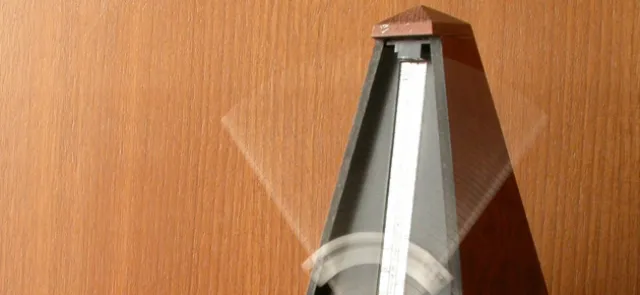
Instruments in the service of music
Marking time, giving music its rhythm by keeping the beat: these are the functions of an object that accompanies many musicians—the metronome. Originally mechanical, it later became electronic, no doubt to keep in tune and move with the times…
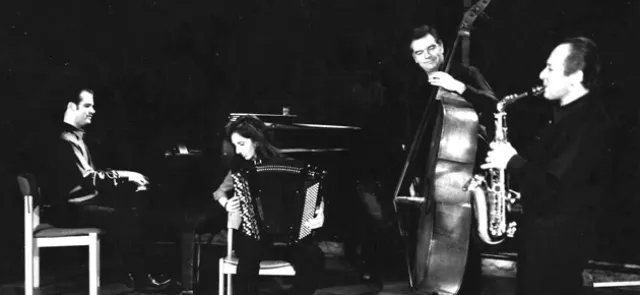
Astor Piazzolla and tango nuevo:
The freedom championed by the rise of contemporary music led Astor Piazzolla to break free from the stifling conventions of classical tango, both harmonically and rhythmically, and create a new form. This evolution in musical structure can be analyzed.
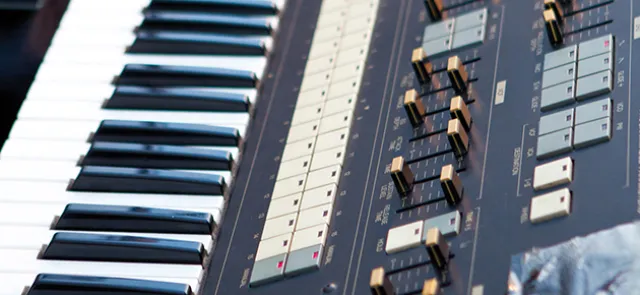
A century of mathematical music | Tangente
Since 1945, contemporary "art" music has become so diverse that any overview is now impossible. Yet technology and the introduction of some form of chance or randomness into composition remain ubiquitous.
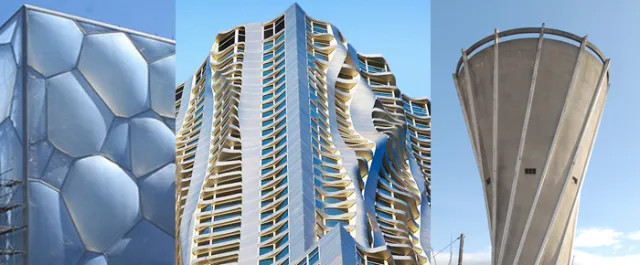
Exceptional surfaces in architecture
Architecture today combines practicality with spectacle. New digital techniques make it possible to design buildings with extraordinary forms.
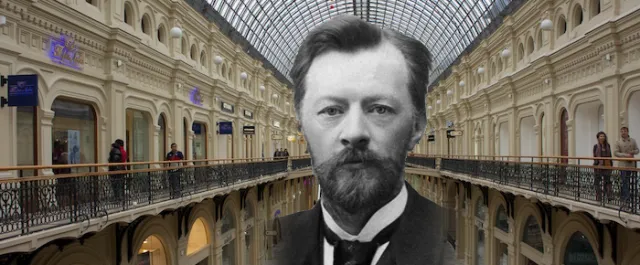
Vladimir Shukhov, Russia's Gustave Eiffel
A mathematician by training, Vladimir Shukhov was one of the leading figures in Russian architecture from 1890 to 1930 and was strongly influenced by Constructivism. His building designs made him a forerunner of contemporary architecture.
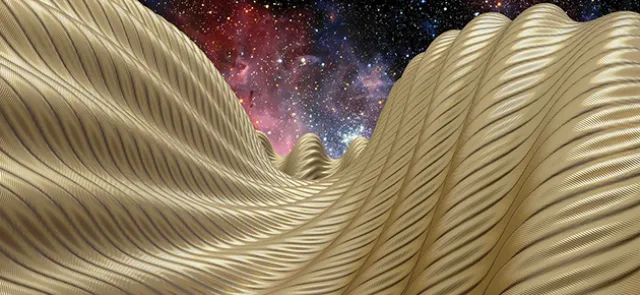
The smooth fractal revolution
How can a sphere be made to occupy less volume? Or how can an object be brought from the fourth dimension into the third? The corrugation technique meets such geometric constraints and produces surfaces both strange and unprecedented: "smooth fractals."
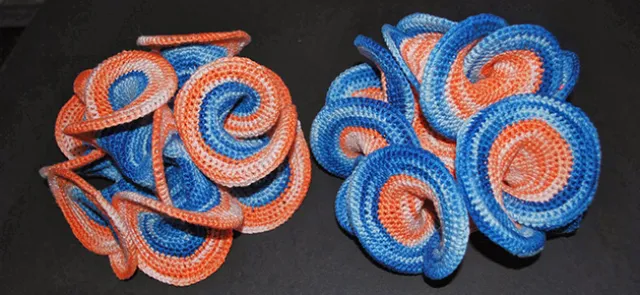
Knitting topological surfaces | Tangente
Knitting is generally used to make clothes. Mathematicians face no such limitations: they are interested in other kinds of surfaces that can be recreated with yarn and a needle. The result? Objects that are at once geometric, educational and… artistic!
Arata Isozaki: Pritzker Prize and geometry | Tangente
Japanese architect Arata Isokazi has just been awarded the Pritzker Prize, architecture's very own "Nobel Prize."
Richard Serra: sculptures and surfaces at the Guggenheim | Tangente
In his installation "The Matter of Time," Richard Serra takes us on a journey through eight monumental sculptures, created between 1994 and 2005 and installed in a gallery at the Guggenheim Museum Bilbao, Spain.
Félix, inventor bridging art and mathematics | Tangente
Sculptor, architect, engineer, mathematician? No doubt all of the above! Gérard Chamayou, known as Félix, was one of those who refused to accept barriers between disciplines, and his gift was to move among them with a provocative yet deeply humane spirit.
Pushkin’s poetry and Markov chains | Tangente
Every written language has its own grammatical and lexical structure. Its sounds are represented by recurring patterns of letters whose combinations are far from chaotic.