



Math for everyone
Mathematical content accessible to everyone
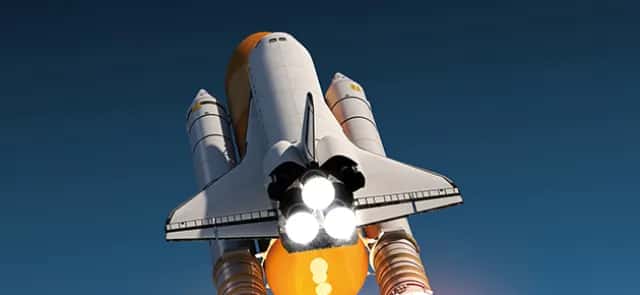
A free ticket to the stars: Newton | Tangente
How far we have come since Newton's famous apple! Recently discovered remarkable properties of the gravitational field raise the prospect of space missions requiring almost no energy—not only to the Moon, but to other planets as well…

An invariant under central projection
The need to model visual perception gave rise to a new geometry. Renaissance painters felt compelled to study it closely in order to depict depth. Lengths, angles: nothing seemed to be preserved, apart from a curious relation linking four collinear points…
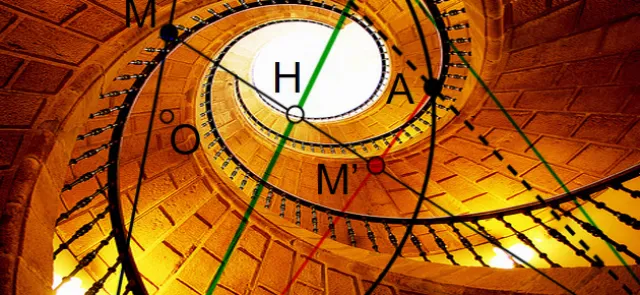
A cross-ratio from another world
During the 19th century, the search for quantities invariant under a particular group of transformations became the main focus of the various branches of geometry. The cross-ratio, a fundamental invariant of projective geometry, also appears in non-Euclidean geometries and their models.

A geometric tool of unparalleled power
The harmonic range, like the more general notion of cross-ratio, has proved essential to geometric reasoning, particularly when dealing with cocyclicity—the property of points in the plane lying on the same circle—or pencils of lines.
Statistics and epidemiology: clusters | Tangente
An article in Science et pseudo-sciences explains the statistical methods used in epidemiological studies, using cases of "babies born without arms" as an example

Arithmetic: Were things really better before? | Tangente
The latest report from the Directorate of Evaluation, Forecasting and Performance warns of declining achievement among pupils at the end of CM2.
Pick up your pens: maths writing competition | Tangente
The publication of Daniel Bouix's article "Coloring the Tiles of the Plane" gives us an opportunity to remind readers that the 2019 Best Article Award competition is now under way. Entrants have until September 30 to submit their work.
Breakthrough in quasi-linear multiplication | Tangente
Multiplying two integers dates back several thousand years. In 2019, at last, the algorithm was improved!
First black hole photograph: Katie Bouman | Tangente
The first photograph of a black hole was produced using an algorithm tasked with assembling all the data collected by a network of telescopes.
Karen Uhlenbeck: first woman to win Abel Prize | Tangente
Following Ingrid Daubechies and Claire Voisin, another female mathematician has been honored this year.
The theorems of Menelaus and Ceva
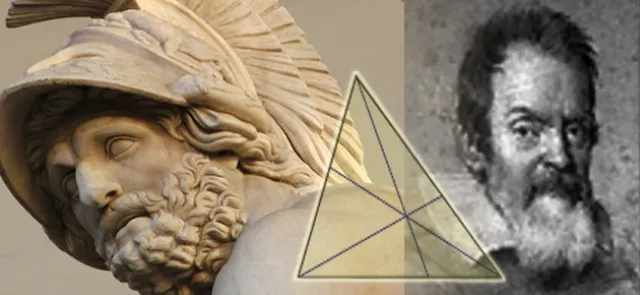
Menelaus's and Ceva's theorems, two classics of plane geometry, are similar in form. This resemblance becomes clearer when the notion of cross-ratio is introduced.
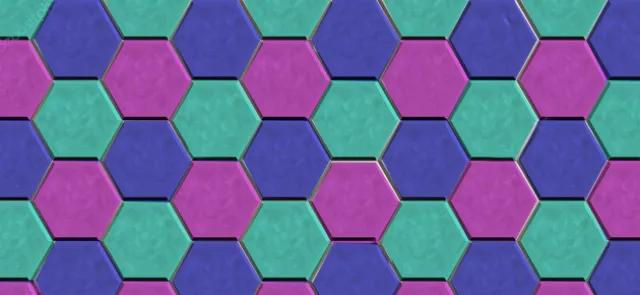
Coloring planar tilings: four colors | Tangente
The proof of the four-color theorem caused quite a stir! Results on colorings using only two or three colors have proved less controversial. By considering how to make a beaded necklace, we can take a fresh look at these coloring questions.
The astrolabe: answers to six practical challenges | Tangente
After reading the article on the planispheric astrolabe, practise using it by answering these questions
Surface and area in mathematics: a little terminology | Tangente
Everyday language often conflates the notions of surface and area.
Intellectual self-defense: zetetics courses | Tangente
Cortecs (Collective for Transdisciplinary Research on Critical Thinking & Science) is a teaching and research collective founded in 2010 to produce educational resources and scientific content, as well as courses and training in critical thinking, intellectual self-defense, zetetics and the scientific method.

Theorizing conspiracy theory through mathematics | Tangente
We often encounter the outlandish claims made by conspiracy-theory enthusiasts. But can we use theory itself to show just how implausible they are?

Maths Night 2019 in Tours and Blois | Tangente
For its fifth edition, the Maths Night festival, held in the Loire Valley, will feature talks, shows, exhibitions and films, all with plenty of humor and conviviality.
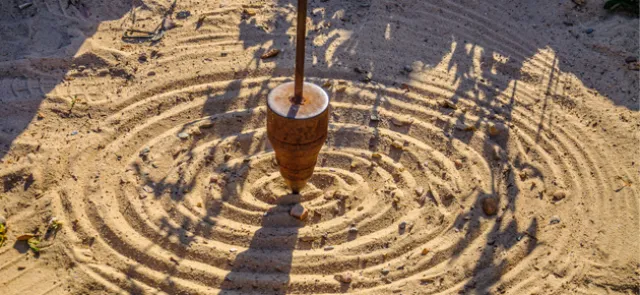
The cycloidal pendulum
The cycloidal pendulum has three key properties: it is isochronous, tautochronous and brachistochronous. Behind these learned names lie fundamental properties—so fundamental, in fact, that we owe nothing less than the birth of clockmaking to the pendulum!
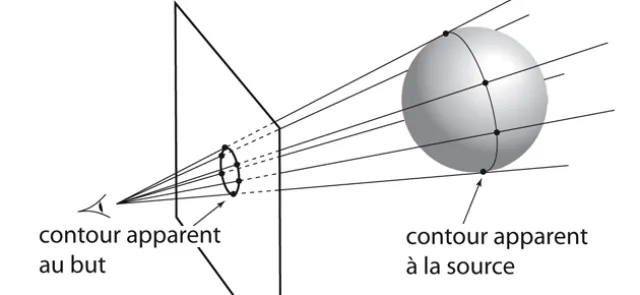
The envelope of a family of curves
Defining the envelope of a family of lines precisely is subtler than it appears. This becomes clear when we try to extend the idea to an arbitrary family of curves. René Thom's approach provides a way around the difficulties.
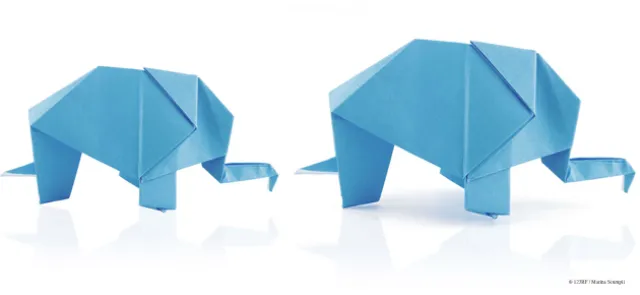
Envelopes by folding
Every regular curve is the envelope of all its tangent lines. For conics, these tangent lines are particularly easy to construct geometrically, making it possible to produce them by folding.