



Math for everyone
Mathematical content accessible to everyone

World harmony dictated by mathematics | Tangente
Beginning with painting, Leonardo da Vinci developed a vision of world harmony governed by mathematics.
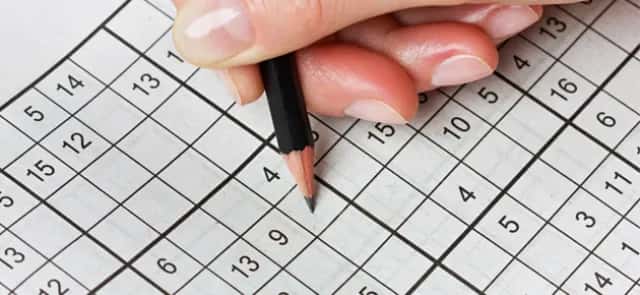
In the press too…
Mathematical games, familiar from the scientific press, are few and far between in the mainstream press. Some newspapers have nevertheless taken the plunge, often with success! There is indeed an audience for recreational mathematics—provided it is not schoolwork in disguise.
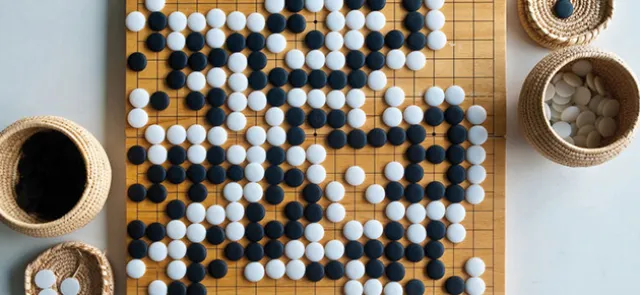
Tabletop games, games in society
Board games, solitaire games, tabletop games, games of chance, video games, traditional games… There is something for everyone, whatever their tastes! As cultural products, games reflect the societies that produce them. But they can also help us develop our mental abilities.
Mathematics lends itself to play
Play does not seem more closely linked to one discipline than another. Yet mathematics and play enjoy a special relationship. Mathematics lends itself remarkably well to play, and play returns the favour.
The mind-bending properties of infinity
Infinity abounds in paradoxes of every kind. For example, the terms of certain numerical series can be rearranged so that they converge… to any number chosen in advance! Skeptical? Follow Bernhard Riemann's reasoning…
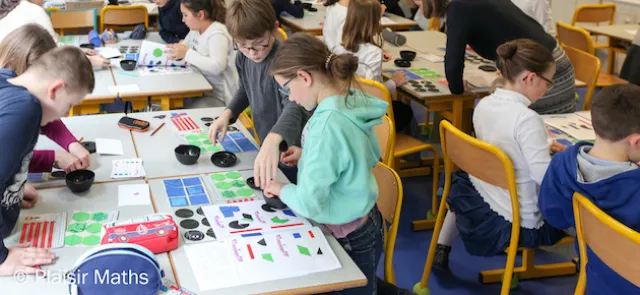
Playing games in mathematics class
Games can play an important role in school mathematics. What if every problem took the form of a game? Here is how, in just a few playful steps, to move beyond the confines of a high-school curriculum.

Finding your position at sea | Tangente
On Earth, a position is identified by two coordinates: latitude and longitude. Finding your position means determining these two values.
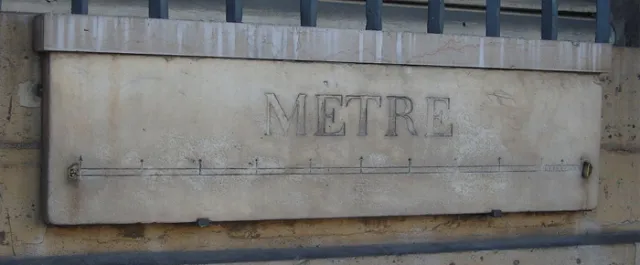
A new definition of the International System of Units
The conference held in Versailles in November 2018 changed four units of measurement, including the kilo. These new units will no longer depend on specific experiments. Their definitions will take effect in May 2019. What better opportunity to look back at the origins and evolution of our units of measurement?

Physics on one side, mathematics on the oth... | Tangente
It would be misleading to regard mathematics and physics as entirely separate disciplines, given the many exchanges and interactions between them. Mathematical physics is, moreover, a nonempty intersection of the two.
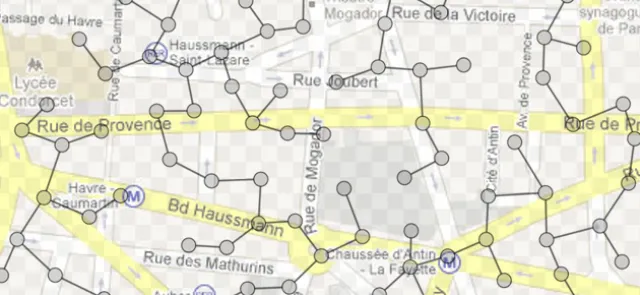
When physics “proves”
Some mathematical results are so vivid, so “concrete,” that they lend themselves beautifully to physical experiments. With a little ingenuity, they can even be “proved” physically! This is true of the Pythagorean theorem, the law of cosines and, indeed, triangle geometry as a whole.
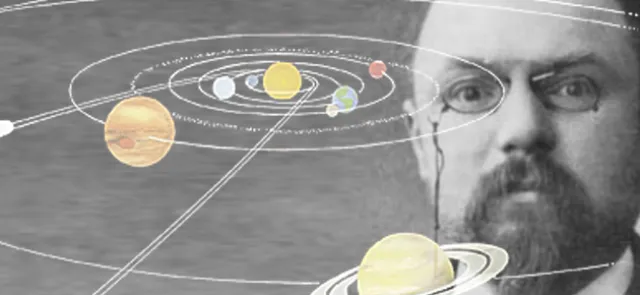
From the three-body problem to mathematical chaos
The elusive three-body problem saw spectacular progress thanks to Henri Poincaré. The French mathematician went further, devising new, more geometric methods for studying dynamical systems. His research has shaped our understanding of the stability of the solar system.
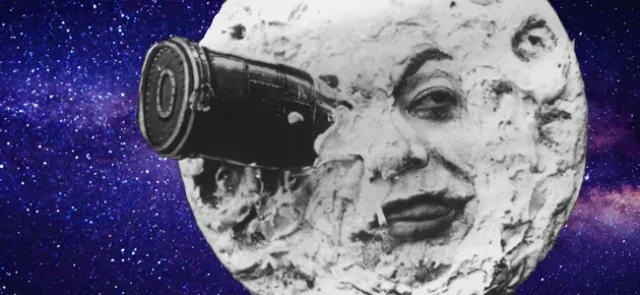
Lagrange and the analytical method
At the time of his death, Isaac Newton was proud to have found a method for solving problems in natural philosophy, but he was aware of its limitations. The Moon's trajectory is described only very approximately by the two-body problem. It fell to Joseph-Louis Lagrange to make a spectacular breakthrough.
Joseph Fourier
At a time when the nature of heat was still being debated in the 18th century, Joseph Fourier established an equation describing how heat propagates through a solid of arbitrary shape. His methods make the French scientist a founder of mathematical physics.
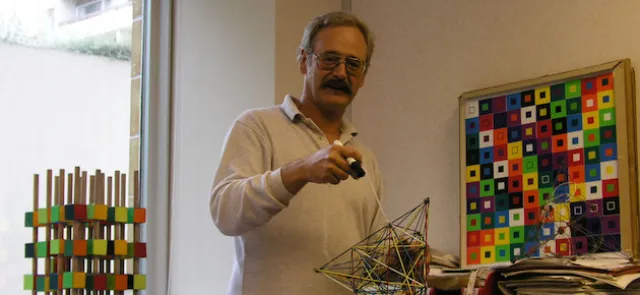
Combinatorics, past and present: An interview with Pierre Duchet
The study of combinatorial structures is a recent branch of mathematics, rich in counting problems. A journey into a far too little-known realm.
South America: Fondation Cartier's ode to geometry | Tangente
Until 24 February 2019, Fondation Cartier is exploring the presence of geometry in art across South America, from Mexico to Tierra del Fuego, spanning pre-Columbian and contemporary art as well as Indigenous American cultures.
Michel Serfati: a passion for the history of | Tangente
Mathematician, philosopher and historian of science, Michel Serfati, who died on September 30 last year, was all three.

Pierre Duchet: research in action | Tangente
Mathematician Pierre Duchet died on October 27 last year at his home in Mexico City. A friend of the editorial team at Tangente, this specialist in combinatorics, discrete mathematics and especially graph theory was always eager to share his work with younger generations.
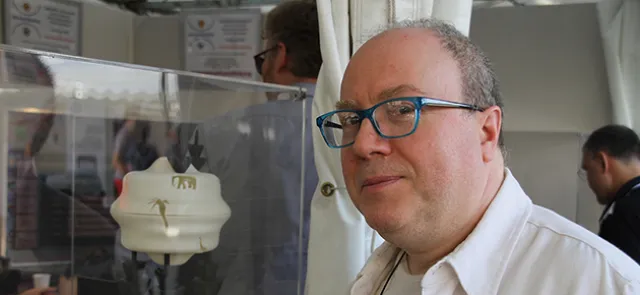
Christian Lavigne | Tangente
Visual artist Christian Lavigne's work achieves a beautiful alchemy of mathematics, art, poetry and, above all, digital sculpture, a field in which he is a leading figure. He created the first French digital sculpture produced using additive manufacturing.

Binary notation for representing data
A computer's memory can store only 0s and 1s. Despite this limitation, we now use it to store numbers, text, photographs and even videos. This encoding relies on a host of standards and conventions that are well worth knowing.
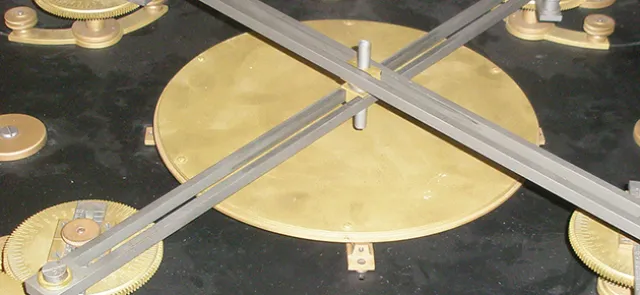
The campylograph | Tangente
At the end of the 19th century, Father Dechevrens, director of the Jersey observatory, devised a curve-drawing machine. Originally designed to plot the paths of the planets as seen from Earth, it could produce many other curves besides epicycles!