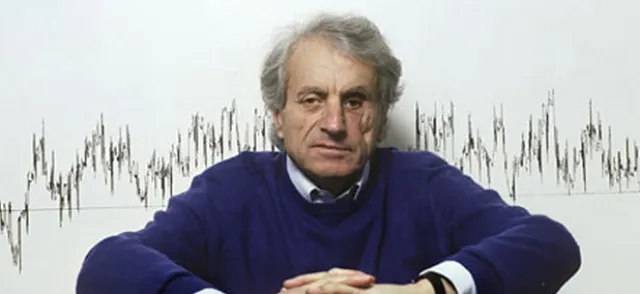
Some of his works bear names referring to mathematical objects, such as Concret PH (“hyperbolic paraboloids”) in 1958. He draws on, among other fields, combinatorics, group theory, probability theory, and even the Fibonacci sequence, and comes close to algorithmic music. One of his earliest works, Pithoprakta in 1956, is a transition between serial music and a more stochastic approach, that is, one involving chance.
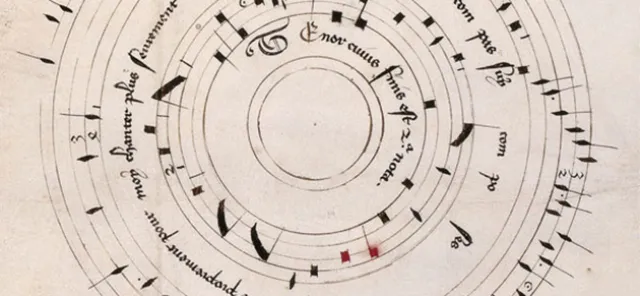
His training as an architect led him to associate graphic forms and music. In 1958, while working with Le Corbusier, he created the Philips Pavilion for the World’s Fair in Brussels, a true sound architecture designed to house Edgard Varèse’s Poème électronique. In the 1970s, the UPIC (Unité polyagogique informatique du CEMAMu) was born from the collaboration between Xenakis and the engineer Patrick Saint-Jean; CEMAMu was the Centre d’études de mathématiques et automatiques musicales, founded by Xenakis. The UPIC is one of the first graphic controllers for digital music; it underwent numerous improvements over time. It consists of a graphics tablet connected to a computer as well as loudspeakers. When the composer works on the UPIC, he associates graphic input and its musical transcription in real time, and he can correct his drawing after listening to the generated sound.
The idea is not so much to represent sounds through an abstract image as to “make drawings sound,” with the sound parameters located on the x (time) and y (frequency) axes of a phase plane. Xenakis says: “This use of modern technology is not a break in the history of music. Music has always been, and continues to be, both sound and number, acoustics and mathematics, which is the basis of its universality.”