



Curiosity
Patterns, crafts, magic squares and fun mathematical content not part of the school curriculum
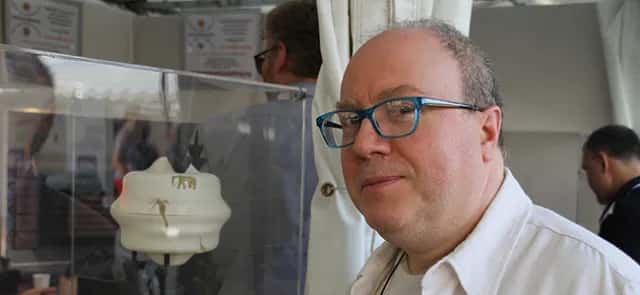
Christian Lavigne | Tangente
Visual artist Christian Lavigne's work achieves a beautiful alchemy of mathematics, art, poetry and, above all, digital sculpture, a field in which he is a leading figure. He created the first French digital sculpture produced using additive manufacturing.

Having fun with the number 60 | Tangente
Although 60 is no longer the retirement age, there are still plenty of opportunities to play with the number 60.

How virtual images are created
How are realistic video-game landscapes created? How can a character and their clothes be made to move as fluidly as possible? The temporary exhibition "Sous la surface, les maths", designed by the Institut Henri-Poincaré and hosted by the musée des Arts et Métiers, explains everything.
False "proofs"
Although fallacious proofs are not scams, they remain a teaching tool that often amuses math buffs… and everyone else!

Ponzi schemes
Pyramid investment schemes, which pay early investors with funds contributed by later ones, have shown their limitations. They can be modeled. Curiously, however, some government practices are not so very different from these models…

Scams, fraud, hoaxes, deception… and mathematics
Archimedes’ example shows that mathematics was once used to expose fraudsters’ tricks. Is that still often the case today? More often than not, no.

Soroban and Japanese human calculators | Tangente
Practising the Japanese abacus is considered an art in Japan, where, as in judo, practitioners progress through kyu belt ranks and then dan grades.

An innovative new kind of calculator | Tangente
The French company Numworks has joined the select club of calculator manufacturers. This new machine is based on open-source principles.

Fast calculation with the Trachtenberg method | Tangente
You may have heard of the "Trachtenberg method" in the recently released film Mary. It is an iterative method for performing impressive mental calculations with large numbers.
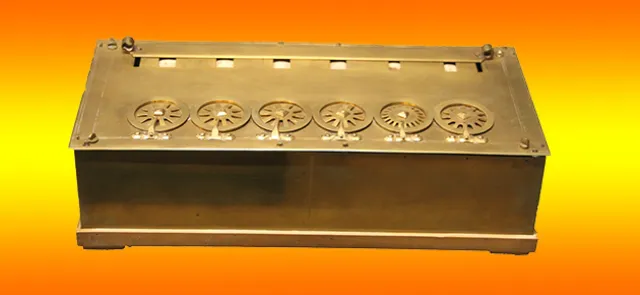
The mechanics of calculation
To calculate faster and more accurately, humans created devices as ingenious as they were varied! It can be hard to imagine that, only a few centuries ago, machines were expensive and cumbersome. Sophisticated calculations were therefore the preserve of an elite.
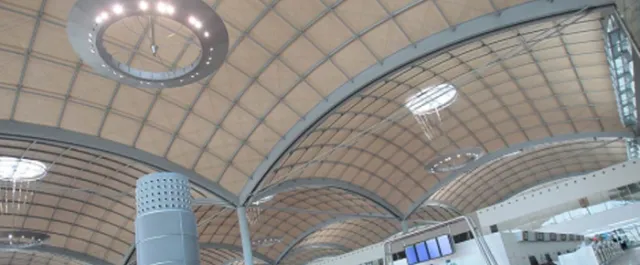
The Bohemian dome
You are certainly familiar with the torus, obtained by rotating a circle about an axis lying in the circle's plane. But what happens if we change the circle's position? We obtain a surface that has long been known and used in architecture...
Reasoning means solving
Reasoning means organizing your thoughts. Yes, but how? Are there methods for keeping our thoughts from descending into anarchy and confusion? Mathematics is, by its very nature, the discipline that has enabled us to answer these questions over the centuries. And it works!

Elementary yet powerful: the pigeonhole principle
If your chest of drawers has two drawers and you put three items of clothing in them, at least two items—possibly all three—must end up in the same drawer. This seemingly trivial observation is actually the basis of a powerful reasoning tool!
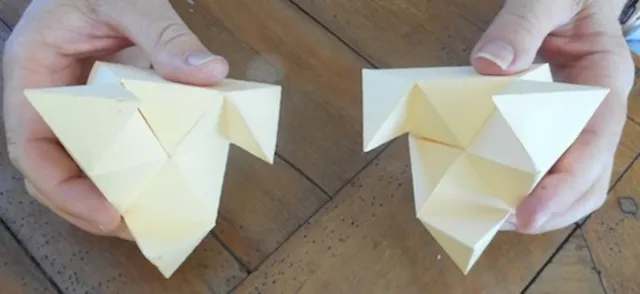
Build your mysterious crystal: patterns & assembly | Tangente
The Mysterious crystal—actually the first stellation of the rhombic dodecahedron—can be built from six identical pieces. Whether you use scissors, a cutting machine or a 3D printer, choose whichever method suits you. The hardest part is working out how to assemble them.
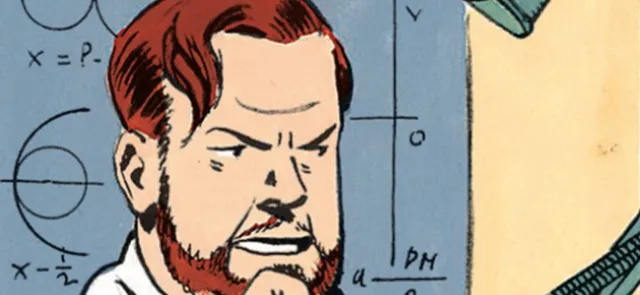
Blake and Mortimer: mathematics in the comics
Scientists are rare among comic-book heroes. Mathematicians are rarer still! One of the most famous scientists among them is Professor Philip Mortimer, from the "Blake and Mortimer" series. Let's examine his relationship with the queen of the sciences.

Crop circles and mathematics: Fibonacci in the fields
Another form of optical art is found in the famous crop circles, or "crop formations" (technically known as agroglyphs). These geometric patterns, most often created in cereal fields, range in size from a few square metres to several hectares. They are made by cutting, twisting or bending stalks of grain, usually at night and in record time.

The ever-surprising curiosities of the harmonic series
The harmonic series is one of the few divergent series that frequently arises in science. In mathematics, naturally, but not only there: it also turns up in a theater, in the guise of an absent-minded spectator who has forgotten his seat number, and in problems involving stacks of sugar cubes.
Au fil des maths: APMEP's new journal
At last, the new journal of the Association des professeurs de mathématiques de l'enseignement public (APMEP) has arrived!

The very delicate principle of indifference
The principle of indifference invites us to reflect on the subtle blend of knowledge and ignorance. The probabilities it generates are sometimes surprising, but always consistent. By analyzing a problem's data, it dictates the probabilities that should rationally be assigned.
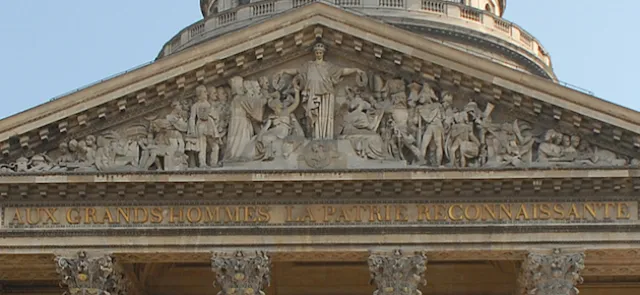
A guided tour of the Panthéon of mathematics
Visiting Paris with your family or a school group, you may be looking for mathematically themed attractions. The Panthéon is unlikely to spring to mind… Yet this monument celebrating the nation's great figures is full of surprises! Follow the guide.