



History and Culture
History of mathematics and cultural connections

The origins of chaos theory with Poincaré | Tangente
The birth of "deterministic chaos" grew out of Henri Poincaré's entry for a prize offered by King Oscar II. The French mathematician's paper would go down in history for containing a major error—one that proved extraordinarily fruitful for science.

Archives Henri-Poincaré: history of science | Tangente
A transdisciplinary team built around Henri Poincaré's name and work
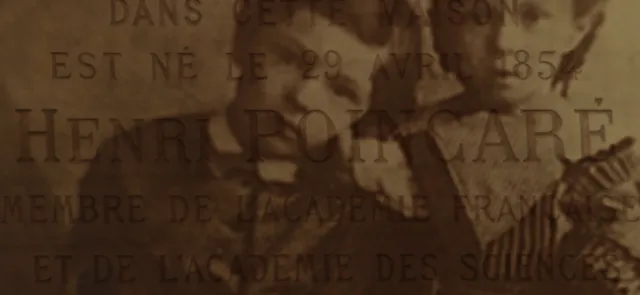
Poincaré, the last great polymath | Tangente
Henri Poincaré embodies an ideal of scientific unity: he mastered every field of science in his day. His name remains associated with a staggering number of mathematical ideas, concepts and objects. More than a century after his death, he continues to inspire mathematicians, physicists and philosophers.

Poincaré: a frequent traveler to scientific congresses | Tangente
Henri Poincaré traveled extensively for academic visits, meetings, and lectures.

Poincaré and free inquiry in Brussels | Tangente
"Freedom is to science what air is to an animal; deprived of freedom, science dies of asphyxiation, like a bird deprived of oxygen."

Poincaré's childhood utopian government | Tangente
In 1867, having just visited the Exposition universelle, 13-year-old Henri came up with the idea of establishing a three-part system of government in the large garden at Arrancy, where he spent his holidays: a kind of federation he called Trinasie.

Mathematical events in Europe | Tangente
The new Pop Math website aims to catalogue mathematical events across Europe.

Beyond the white dimension | Tangente
A Tale of Synapse is a video game that immerses players in a mathematical universe.

Poincaré's irony about logicism | Tangente
Henri Poincaré regarded experience and intuition as essential to the foundations of mathematics. He was therefore often ironic, even caustic, toward those who relied on abstract logic to provide a foundation for arithmetic

Poincaré vs Hilbert: intuition and logic | Tangente
The debate between Henri Poincaré and David Hilbert illustrates two opposing views of the nature of mathematics.

Tokyo Olympics: a mathematician strikes gold | Tangente
Mathematician Anna Kiesenhofer won a cycling gold medal at the Tokyo Olympic Games.
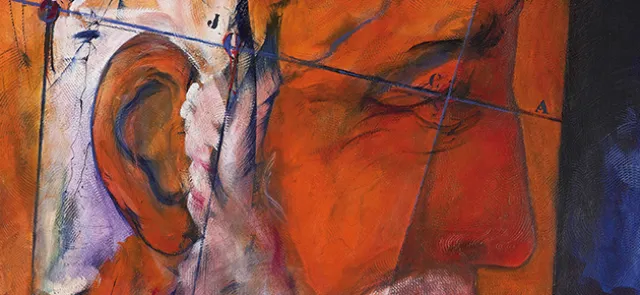
Jacques Dominioni, painter of geometry | Tangente
The work of the painter Jacques Dominioni (1934–2014) belongs primarily to lyrical abstraction. Yet his mastery of basic geometric forms—lines, circles and the grid structure underlying his paintings—is thought-provoking... and moving. Let's explore the different periods of his artistic output.

Euclid's algorithm, et cetera
A history of arithmetic—or how an algorithm dating from the third century BCE has endured through the ages and evolved to serve modern disciplines, particularly computer science and cryptology.
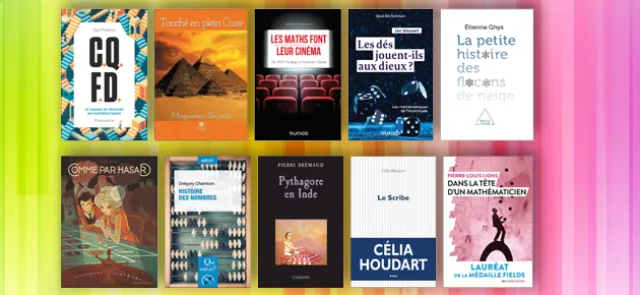
Tangente Awards: take part! | Tangente
The awards organized by the Club Tangente continue to go from strength to strength! Enthusiasm seems to grow every year: publishers keep an eye on the literary prizewinners, while readers submit articles or puzzles and vote for their favorite books.

Vote for the 2021 Tangente Prize | Tangente
Every year, Tangente's online followers and regular readers are invited to vote for their favorite popular mathematics book.

An Interview with Cédric Villani | Tangente
A 2010 Fields medallist and member of the Académie des sciences, Cédric Villani has become a leading advocate for mathematical culture. In early 2017, following Emmanuel Macron's rise to power, he became an MP for Essonne. What impact has this eminent mathematician's entry into politics had?

The haberdasher's puzzle and Dudeney's puzzle
Any polygon can be cut into finitely many pieces and rearranged to form any other polygon of the same area. This property holds in the plane, but its three-dimensional counterpart is false. It was conjectured by the Hungarian mathematician Farkas Bolyai (1775–1856).

Euler's 36 officers problem | Tangente
In 1779, while the Swiss mathematician Leonhard Euler was at the court of Catherine of Russia, she asked him to investigate a problem that had been circulating in Saint Petersburg for some time, but that no one had managed to solve.

Sylvester's problem | Tangente
In 1893, the British mathematician James Joseph Sylvester (1814–1897) posed the following question in the Educational Times.

Forerunners in mathematics publishing | Tangente
On a more modest scale, several French-language magazines preceded Tangente. Some of those featured on this page even ceased publication to help launch Tangente.