



History and Culture
History of mathematics and cultural connections
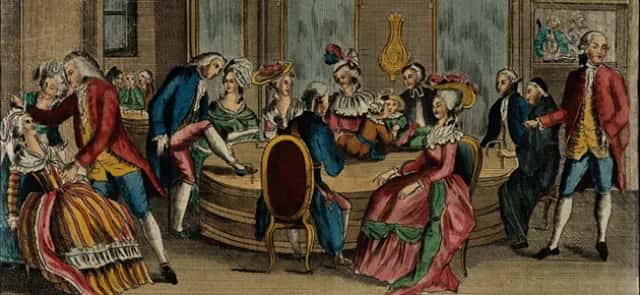
Condorcet, pioneer of scientific skepticism | Tangente
Responding to the vogue for Mesmerism—what we would now call a pseudoscience—Condorcet may be regarded as a pioneer of scientific skepticism. His analyses remain as relevant and timely as ever.
Sophie de Condorcet, a figure of the Enlightenment | Tangente
Born around 1763, Sophie de Grouchy married Condorcet, whom she had met at the home of her uncle and mentor, President Mercier du Paty.

Condorcet and the transmission of knowledge | Tangente
At the end of the preface to his Essais d’Analyse, Condorcet includes the Latin quotation "vice fungar cotis, acutem reddere quae ferrum valet, exsors ipsa secandi," from Horace’s Ars Poetica (line 305).

Julie de Lespinasse and d'Alembert's salon | Tangente
Julie de Lespinasse, a highly cultured woman and close friend of d’Alembert, opened a salon in 1764 at the corner of rue de Bellechasse and rue Saint-Dominique.
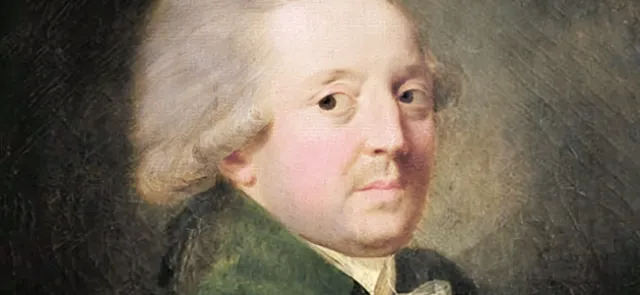
Condorcet: a true Enlightenment mathematician | Tangente
Although Condorcet is best known today as a philosopher, he began his career as a mathematician. A precocious polymath, mathematics also led him to politics and philosophy.

Pentagonal architecture: towers, castles and the Pentagon | Tangente
The pentagonal tower has stood since the 14th century in Castellane, a fortified town and subprefecture of Alpes-de-Haute-Provence.
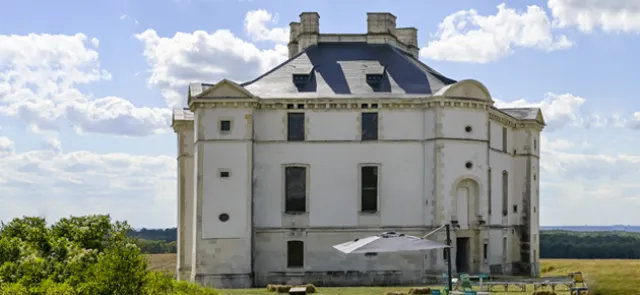
Maulnes Castle: Renaissance architecture on a pentagonal plan | Tangente
Few people know that less than 200 km from Paris stands a Renaissance castle built to a pentagonal design. Only a handful of such buildings can be found anywhere in the world...
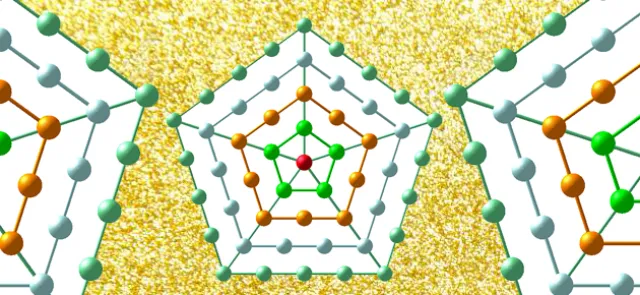
When polygons form numbers
All is number! The Pythagorean school established many properties of numbers from their geometric representations. First developed for triangles and squares, this way of arranging numbers was later extended to all kinds of polygons.
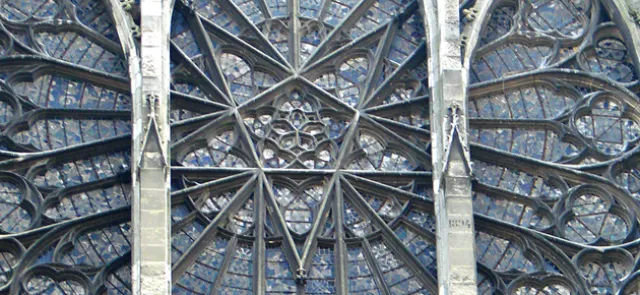
Pentacles and pentagrams: symbols and mathematics | Tangente
The pentagram, also known as the star pentagon, is a non-convex pentagon formed by joining every other vertex of a regular pentagon. It has journeyed through the ages and across civilizations, always shrouded in mystery.

A little gem from Gauss
Triangles and quadrilaterals have inspired a wealth of mathematical literature. Yet few people seem to have taken a close interest in pentagons before a certain Carl Friedrich Gauss, who gave us a little gem for calculating their areas.

Pythagoras and Heron
Heron's formula emerges when we seek to express the area of a triangle in terms of its side lengths. A variation of the argument recovers the Pythagorean theorem.
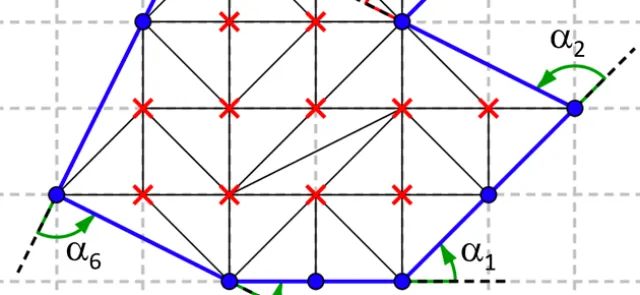
Pick's theorem: an inspiring formula for polygonal area | Tangente
Some theorems, through the simplicity of their statements and the originality of their proofs, become enduring examples of mathematical creativity. Pick's theorem is one such example.

Albert Girard, pioneer of classification | Tangente
The historian of mathematics Siegmund Günther (1848–1923) asserts that Albert Girard of Lorraine (1595–1632) had already given a general definition of the polygon in his 1626 table.

Polygon names: etymology and nomenclature | Tangente
The word "polygon" comes from the Greek poly, "many", and gonos, "angle, corner", which some authors link to gonou, "knee", the body's archetypal angle.
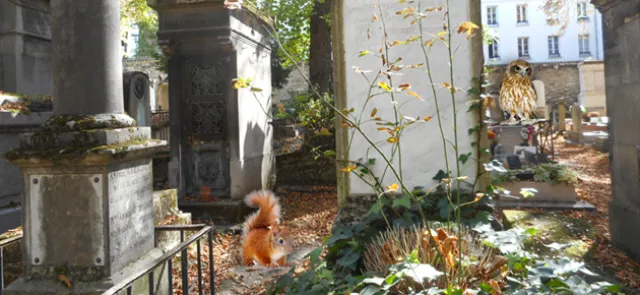
The mathematicians of Père-Lachaise | Tangente
At this time of year, around All Saints’ Day, tradition calls for visits to cemeteries. So let's take the opportunity to visit the graves of mathematicians in the most iconic cemetery of all: Père-Lachaise.

Daniel Litt's probability problems
The young mathematician Daniel Litt currently holds a position at the University of Toronto. His research usually explores the interplay between algebraic geometry and arithmetic. Yet in recent months, he has attracted attention in an entirely different field, even earning an interview with the renowned online publication Quanta Magazine.
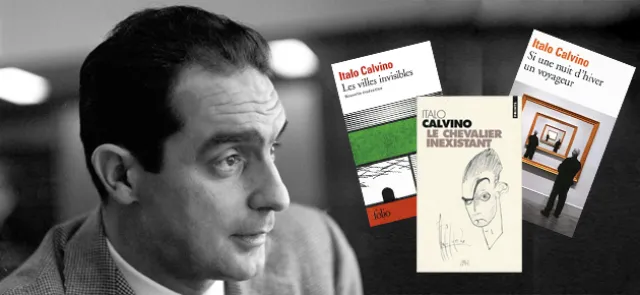
Italo Calvino's mathematical writing | Tangente
Widely read in Italian schools and universities, Italo Calvino is a major author, renowned for the literary quality of his work. He was also an avid lover of mathematics and readily drew on it in his writing, particularly to structure his texts, as one would expect of a committed Oulipian.

Working environments for mathematicians
The abstract notion of space in mathematics is very different from what intuition suggests. Depending on the type of structure available, we can work with concepts from algebra, analysis, or geometry.
Thales’ children
Many proofs in elementary geometry rely on proportionality. Almost all of geometry’s classic theorems involve it: Thales, Ptolemy, Menelaus, Ceva, Pappus… Here is a brief tour of these great problems.
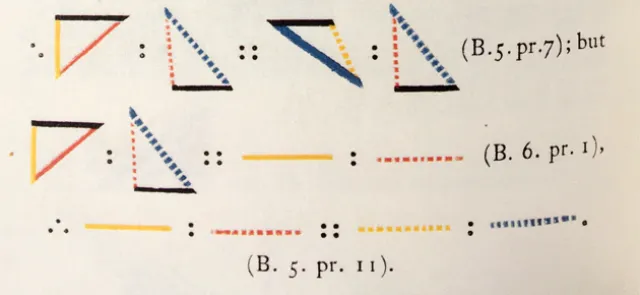
In Euclid's work
Ancient geometers struggled to handle ratios of lengths or areas that were not necessarily commensurable, because they could not conceive of irrational numbers. The definition found in Euclid's Elements remained in use until the 19th century.