



Math for everyone
Mathematical content accessible to everyone

The scant remainder of Euclidean division
When we divide a by n using Euclidean division, we obtain a remainder. This remainder can take only a limited range of values: there are just n of them. This new perspective can simplify many calculations and cast a whole host of problems in a different light!

Division algorithms
From the abacus to the counting frame, what a long way we have come to reach our present-day algorithm, so well known to schoolchildren.

Mathematician and pianist: a winning composition | Tangente
The final of the 27th international competition for great amateur pianists, bringing together 92 candidates from 27 different countries, took place on April 10 at the grand amphitheater of Assas in Paris.

Drawing a line on a computer
What could be simpler than drawing a line between two points? All you need is a ruler and a pencil! But how do you do it on a computer screen? How does graphics software manage it? The task is to turn certain points on the screen black. But which ones?
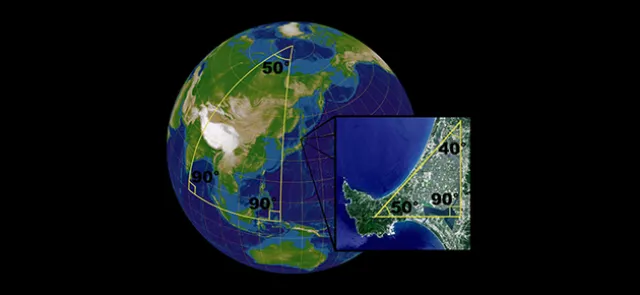
The projective line: a fruitful new perspective
The line is the simplest geometric figure imaginable. The variety of situations encountered in geometry may seem more complicated, and yet… might there be a special perspective from which the plane could be understood as a line? That is precisely what projective geometry is about!
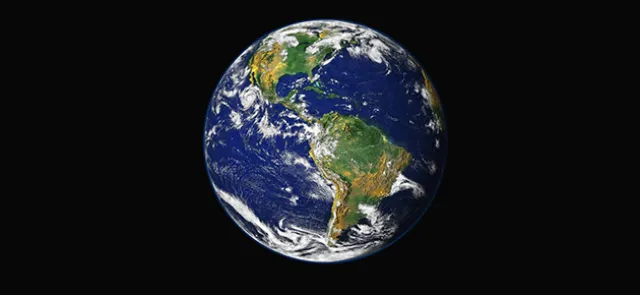
Straight lines in curved spaces: geodesics
If we restrict ourselves to a surface, the shortest path from one point to another is called a geodesic. This concept leads "straight" to non-Euclidean geometries and applications in navigation and cartography.
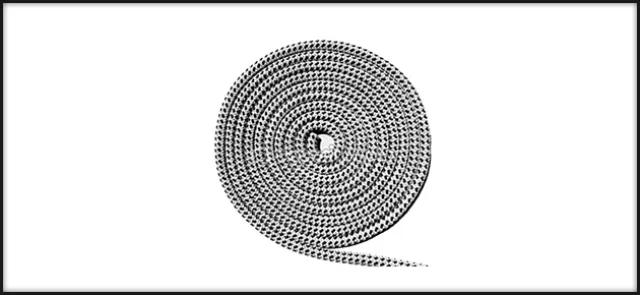
Tangents and asymptotes
From yesterday's "touching line" to today's tangent, from "vanishing quantities" to asymptotes, the story has been a long mathematical epic. Here are a few glorious episodes from this geometric quest to "approximate curves with straight lines."

Caustic envelopes
Lines whose direction varies continuously may reveal the curve to which they are all tangent. Such curves, enveloped by straight lines, appear in optics as caustics. Their properties give rise to geometric construction methods.
Harmonic pencils of lines
How can we express simply that several lines are concurrent? Despite appearances, pure geometry is not the best tool for the job! Introducing a coordinate system and a few equations may prove more useful.

Surfaces… made of straight lines!
A plane is generated by straight lines, and one might think it is the only surface that can be constructed in this way. But that is not so! Surfaces generated by straight lines even have a name: ruled surfaces.
Miraculous collinearity theorems!
A ruler, a compass, a sharp pencil—and the adventure has already begun! It can come as quite a surprise when three points turn out to lie on the same line. Plane geometry abounds in wondrous collinearity theorems.

Lines that have a name (2)
Some lines have a name, and some mathematicians have their own line.
Euclid: an introduction to the straight line
Written more than two thousand years ago, Euclid's Elements is a foundational text of classical geometry. The concept of the straight line is central to it. Let's meet this scholar of ancient Greece and take a closer look at his view of the straight line.

These lines that bear a name (1)
Some lines carry a mathematician's name. They are generally lines associated with the triangle, linked to certain notable points.
The topological line
The topology of the real line underpins the concept of a limit and hence, among other things, those of continuity and differentiability. It deals with notions of proximity between points that arise from the order relation.

Equations of a line
What defines a line, and in what geometric setting? Each possible answer leads to a representation from which the corresponding equations follow.

Geometry or numbers? The number line
It is easy to picture numbers as points on an oriented line with an origin. Yet this construction must be carried out with some rigor—especially if we want to represent infinitesimal or infinite numbers!

Without straightedge, without compass: Mascheroni | Tangente
Every straightedge-and-compass construction can be carried out with compass alone. This rather extraordinary result comes as a surprise.

The number line: definitions versus intuition
In the 19th century, mathematicians sought rigorous definitions of the quantities that make up the continuum of the line. How did they rigorously characterize the real continuum?
Straight lines and optical illusions — geometry | Tangente
For a mathematician, a line is a point in motion. For an artist, however, it is what defines the outlines of things. Without lines, there could be no shapes…