



Math for everyone
Mathematical content accessible to everyone
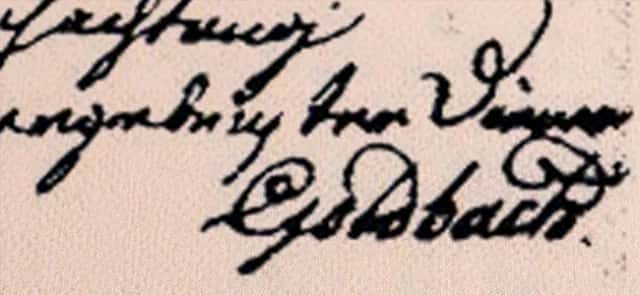
A passion for Goldbach's conjecture | Tangente
In set theory, which Cantor founded, intuition has little place. Yet his approach to open mathematical problems relied more on intuition than on rigorous reasoning. His interest in Goldbach's conjecture is a case in point.

Geometry theorems
With the country cut off almost entirely from the world during the Edo period, Japanese mathematics developed in isolation for more than a century and a half. It was during this period that highly distinctive geometric puzzles flourished and prospered.
Cantor−Bernstein:
Georg Cantor left his mark on the history of mathematics through his study of infinite sets. The Cantor–Bernstein theorem shows how a few results that are obvious for finite sets generalize to infinite sets… provided one takes a serious look at the question.
A journey into infinity | Tangente
While many mathematicians toiled in the footsteps of their predecessors, Cantor opened up an entirely new field that many of his colleagues refused to enter. This journey through the different infinities proved to be both fascinating and fruitful.

Catriona Agg's geometry puzzles | Tangente
Catriona Agg (until recently also known as Catriona Shearer) is a British mathematics teacher from Cambridge.

Envelope of a parametrized family of lines | Tangente
Using tangency, a family of lines can also define a curve.

A remarkable line: the asymptote
A look back at some properties of asymptotes...

Tangents and derivatives
For many people, tangents and derivatives go hand in hand.

The beautiful geometry of sangaku
A sangaku was originally a Japanese wooden votive tablet. It sometimes bears an engraved geometric figure with the statement of a problem, together with the solution or sometimes a hint.
Constructing tangents
If we know how to carry out the classic straightedge-and-compass constructions, we are perhaps less at ease drawing the common tangents to two circles. Now is the time to put our whole range of knowledge of Euclidean geometry into practice!
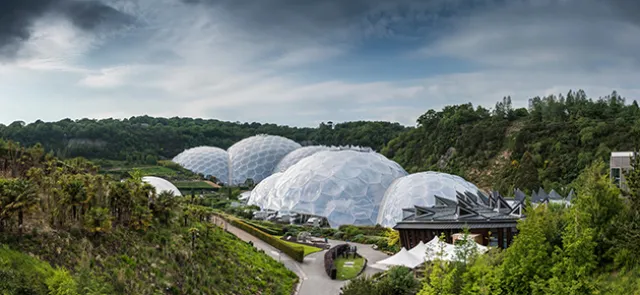
The revenge of the tangent spheres in 4D | Tangente
By shedding new light on the semiregular polyhedra of space, Alicia Boole Stott's method makes it possible to go further and explore objects in the fourth dimension. In particular, she was able to set out in search of semiregular polytopes.

Curves made of straight lines: string art | Tangente
String pictures—decorative designs drawn or made with thread or cord—enjoyed their heyday around 1975. Today they are back in fashion under the name string art.
Different types of tangency in microeconomics | Tangente
In microeconomics, certain arguments rely on a graphical representation and call upon different types of tangency. This is the case with basic consumer theory, the Edgeworth box, and a firm's long-run average cost.
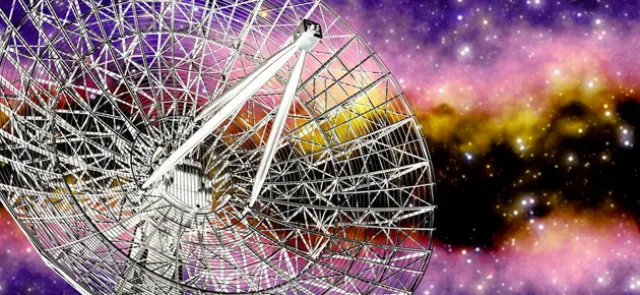
When waves go off on a tangent
Whether reflecting sound or waves, parabolic reflectors rely on the properties of tangents to conic sections. Let's fully dissect the underlying geometric phenomenon exploited in the making of antennas of every kind.

Tangent or asymptote?
Confusing "tangent" and "asymptote" is a very common mistake: what student has never made it? Yet the distinction between the two notions is perfectly clear. An exploration of certain constructions in projective geometry will nonetheless force us to call our certainties into question.
Deviation of a curve from a tangent
Newton and Leibniz, the founders of differential and integral calculus, studied how a curve deviates from a tangent. To this end, they drew on the notion of curvature. The fundamental ideas of these two scholars gave rise to contemporary mathematical analysis.

Observing curves with magnifying glasses
Used appropriately, extremely powerful magnifying glasses make most curves appear to coincide locally with a tangent line or an osculating circle.

Beyond Descartes
Several results in the plane and in space generalize Descartes' theorem on the curvatures of tangent circles.
Touching circles
Euclid's Elements, the standard reference for centuries, established straightedge-and-compass proof as the norm in geometry. But many problems involving circles tangent to one another become simpler when using conics or transformations, such as the indispensable inversion.
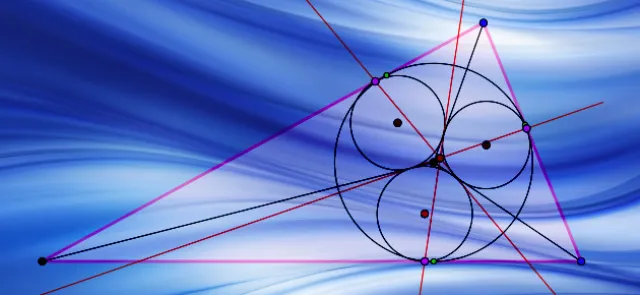
The Malfatti circles in a triangle | Tangente
In a triangle, how should three non-overlapping circles be chosen so as to minimize the area of the triangle left over once the three circles are removed? A natural solution, involving tangents within the triangle, is not the best one, but it gives rise to interesting problems.