



Mathematical Themes
Explore the major mathematical themes: geometry, algebra, analysis, arithmetic, logic, and many other fascinating fields.
Pascal's triangle: a thousand-year history | Tangente
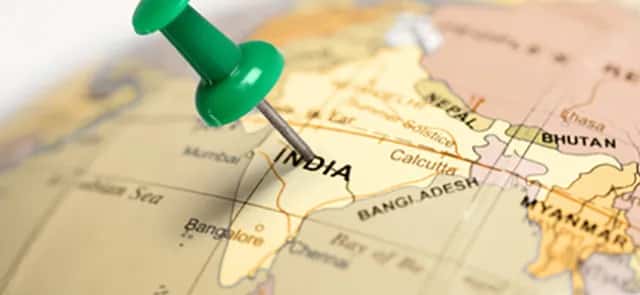
"Pascal's triangle" may have been discovered by Indians more than two thousand years ago. It reached the Arab-Muslim world and China as early as the 11th century. It did not appear in Europe until the 16th century, when Blaise Pascal began to study it rigorously.

Speeding up integer multiplication | Tangente
Complex numbers seem very far removed from the modern world’s concerns about profitability. Yet they underpin methods used to speed up the multiplication of large integers. They save time—a great deal of time—and therefore money!

Perpendicular bisectors, angle bisectors & beyond | Tangente
Equidistance is introduced very early in geometry. Perpendicular and angle bisectors are the simplest examples. Let us go further and consider points equidistant from a line and a circle, from two circles, or even from two more general curves. How far can we take this?
? is an algebraically closed field
The field ? of complex numbers was constructed to provide solutions to every quadratic equation. Surprisingly, it also contains the solutions to all algebraic equations with coefficients in ?. In technical terms, it is algebraically closed.
What is a complex number?
The set of complex numbers gained acceptance—with difficulty—when it became necessary to look beyond the real numbers for all the solutions of a quadratic equation. What no one had anticipated was its richness and the links it would forge with mathematics as a whole. Early discoveries.
Those equation fanatics who created imaginary numbers
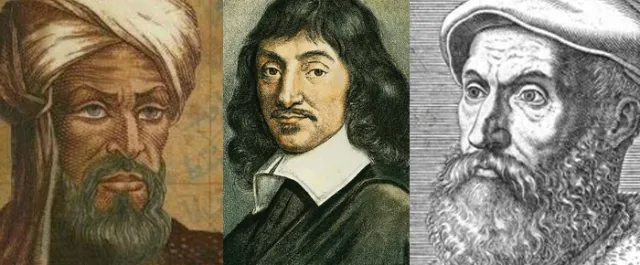
Complex numbers, initially termed "imaginary," were not conceived as we study them today. Above all, they were introduced as tools for solving polynomial equations—and tackling the mathematical challenges that raged across Renaissance Europe.

Pascal's triangle, programming and Fourier | Tangente
Rich in countless combinatorial and numerical properties, Pascal's triangle is ubiquitous in mathematics. Some of its applications in analysis, however, remain little known. The capabilities of the fx-CP400+E computer algebra calculator suggest a signal-processing activity.
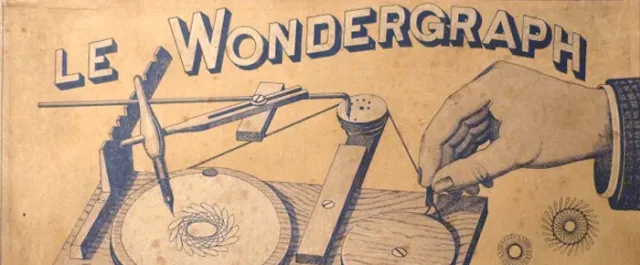
Astounding strophoids: curves and loci
Studied for nearly two centuries before acquiring their final name, strophoids have many interesting properties arising from their similarity under a particular type of transformation. They therefore appear as loci in several classic problems.
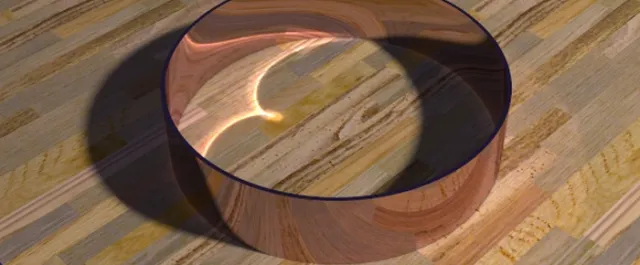
Caustics: curves of light and geometry | Tangente
In optics, the caustic of a curve is the envelope of the light rays emanating from the sun or another source. One appears in your breakfast cup every morning, illuminated by your kitchen or conservatory lights…
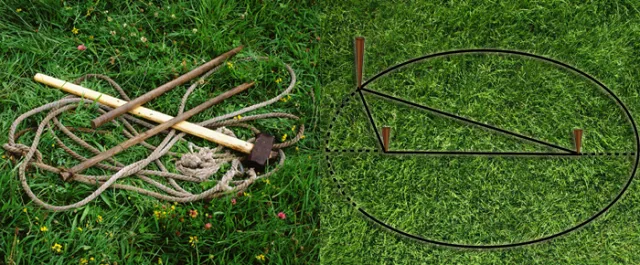
Curva ex machina: mechanisms and curves | Tangente
Do you know Kempe's universality theorem? This 19th-century result states that any algebraic curve can be drawn by a linkage. Today, computers and robotics have replaced the ingenious mechanisms devised by scientists of the past.

The circles of Apollonius of Perga: harmonic ratios
The set of points whose ratio of distances to two fixed points A and B is constant is called the Circle of Apollonius. Three ways to approach it: classical geometry, analytic geometry, and electricity
Finding geometric loci: methods | Tangente
Geometric loci: the term has a whiff of grandfather's geometry about it. Nowadays we'd talk about the set of points satisfying a given property. The old terminology gives the problem a more spatial, physical feel. How have the mathematical tools for studying loci evolved?
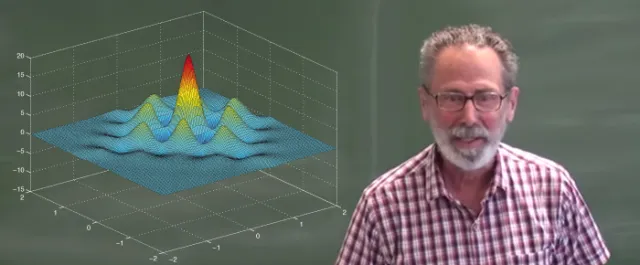
Wavelets and file compression | Tangente
In March, Yves Meyer received the Abel Prize for "his pivotal role in the development of the mathematical theory of wavelets." Emerging in the early 1980s, the field quickly became indispensable to image processing. The JPEG 2000 compression standard is based on it.
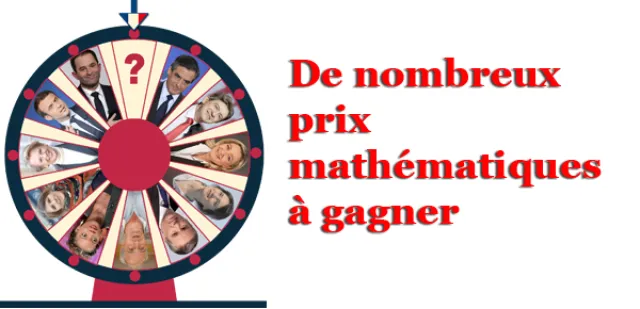
Betting on the presidential election: probability and polls | Tangente
To mark the French presidential election, which coincides with Tangente's feature on betting, we are inviting our readers to bet… on the candidates' shares of the vote! It is free to enter, with thousands of euros in vouchers to be won.
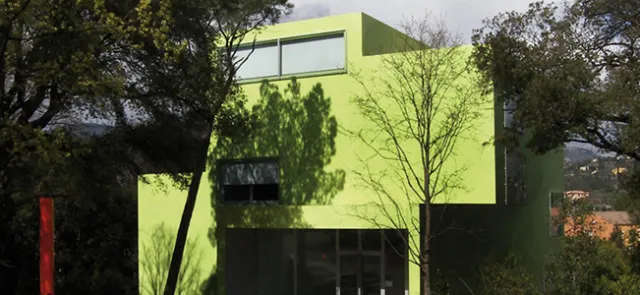
Espace de l'art concret: maths and geometry | Tangente
In Mouans-Sartoux, in the Alpes-Maritimes, a strange apple-green cubic building catches the traveller's eye. Dedicated to concrete art, it gives pride of place to geometric abstraction. In particular, works by François Morellet and Josef Albers can be found there.
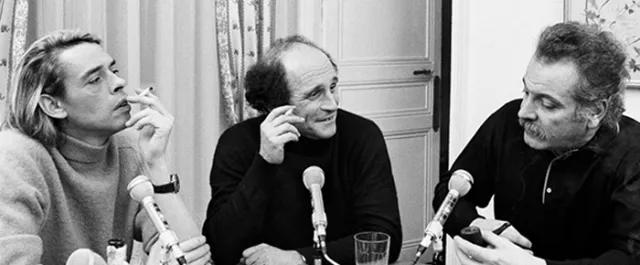
Correspondence analysis
How can social data be examined without falling prey to preconceived ideas or stereotypes? Correspondence analysis, though now losing ground to other techniques, is a method that makes it possible to replace common sense and preconceptions with neutral, objective factors.

Sociologists and mathematicians: Condorcet, Quételet | Tangente
Throughout the 20th century, mathematicians drew on their knowledge and developed statistical methods to gain a better understanding of sociology.
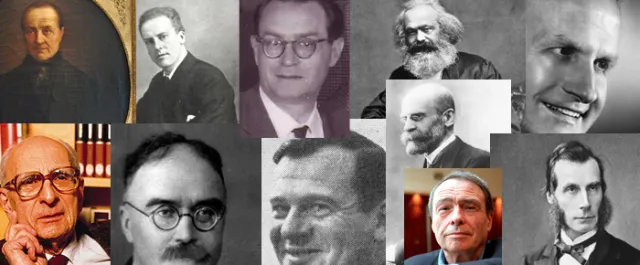
Christian de Montlibert: Sociology is a science | Tangente
Emeritus professor at Marc Bloch University in Strasbourg, Christian de Montlibert is a passionate advocate of using statistical methods in sociology. He stresses the importance of grounding sociology in mathematical methods.

Preference modelling: voting and social choice | Tangente
We are all constantly called upon to make choices based on our preferences. Modelling them is a crucial step in decision support and is therefore of interest to the social sciences, particularly sociology.

Social networks
Long before the term "social network" became widely used for online platforms that enable social interaction, researchers had studied networks of interpersonal relationships and defined concepts describing their main properties.