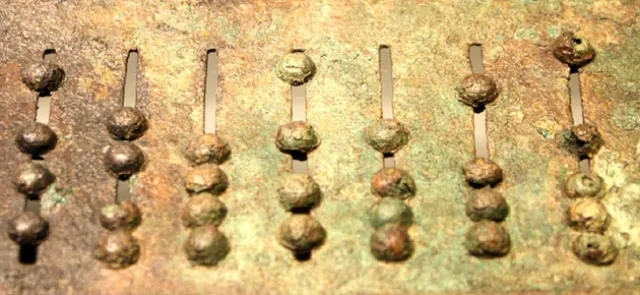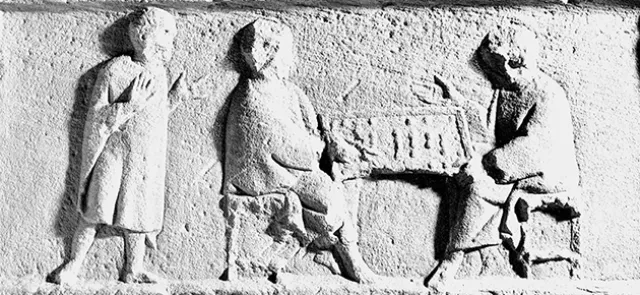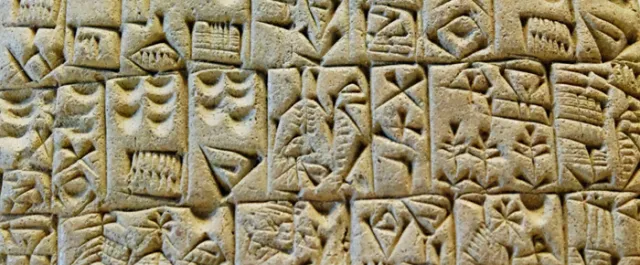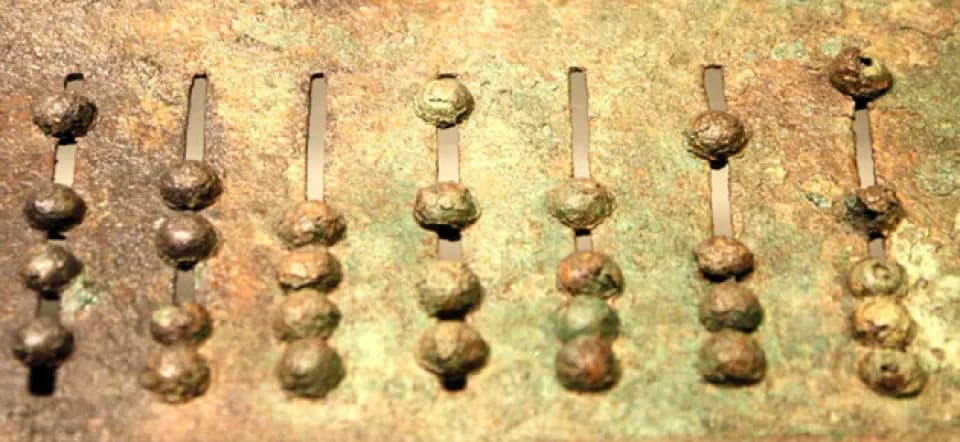
Archaeological excavations, while they make it possible to recover traces of the daily lives of ancient peoples, also provide an opportunity to bring mathematical objects to light: counting sticks or more sophisticated devices, calculation tablets, papyri recording the solution of certain problems, instruments for astronomical positioning or terrestrial measurement, tools for geometric drawing… Let us take an overview of these mathematical instruments of Antiquity, used from Prehistory until the end of the Roman Empire, in the year 476 of our era.
Calculation
=================================================================================================================
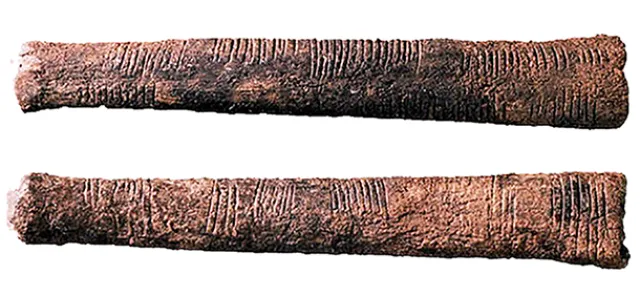
After the hand, which makes it possible to “count on one’s fingers,” the oldest natural aids to calculation are sticks — or any elongated object — and pebbles. To become calculation tools, these objects must be specially shaped to represent numbers. The oldest of these artefacts appears to be the Lebombo bone, found in a cave on the border between South Africa and Swaziland in 1970, and dated to around 43,000 years before our era. Made from a baboon fibula, it is engraved with twenty-nine clearly distinct notches, perhaps to serve as a lunar calendar.
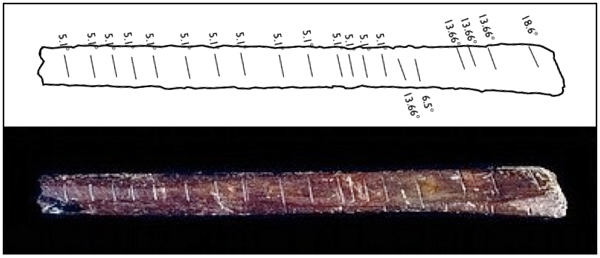
The Lebombo bone.