

All articles
Dive into the fascinating world of mathematics with our captivating articles, written by passionate experts. Whether you are a curious amateur or a seasoned mathematician, our articles cover a wide range of topics, from fundamental concepts to the latest discoveries, including practical applications and philosophical reflections.

Robbins pentagons
While the geometry of triangles and quadrilaterals has been studied in detail for many centuries, the geometry of pentagons has only recently begun to be explored. Let's follow in the footsteps of Heron, Brahmagupta and Robbins.

Pythagoras and Heron
Heron's formula emerges when we seek to express the area of a triangle in terms of its side lengths. A variation of the argument recovers the Pythagorean theorem.

Heptadecagon: fact and fiction
Theory tells us that a regular seventeen-sided polygon—a heptadecagon—can be constructed using only a straightedge and compass. But it gives no details of the construction, which is far from straightforward.

Tangential quadrilaterals
Engineer Henri Pitot (1695–1771) is remembered for the tube that bears his name, which he proposed in 1732 to "measure the speed of flowing water and the wake of ships" and which is still widely used in aerodynamics. But geometry was this self-taught scholar's first love.

Polygon taxonomy: triangles and quadrilaterals | Tangente
Just as a taxonomist inventories and classifies living species, whether animal or plant, let us classify the simplest polygons by comparing their angle measures and side lengths.
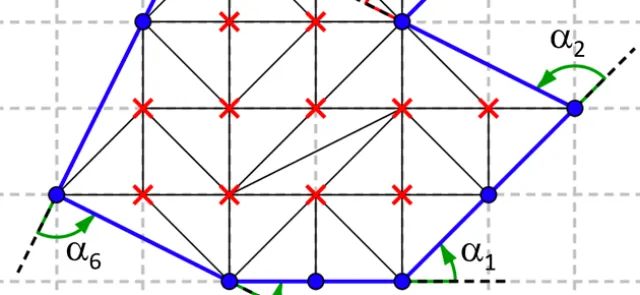
Pick's theorem: an inspiring formula for polygonal area | Tangente
Some theorems, through the simplicity of their statements and the originality of their proofs, become enduring examples of mathematical creativity. Pick's theorem is one such example.
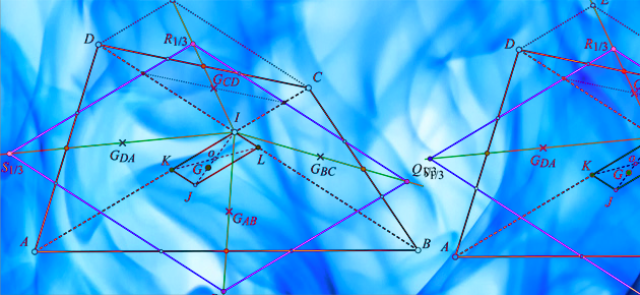
Convex quadrilaterals
Three sides completely determine a triangle, up to orientation. With four sides, infinitely many polygons can be constructed. Nevertheless, many general properties can be established for arbitrary convex quadrilaterals.

Inside and outside a polygon | Tangente
How can we systematically determine whether a point lies inside or outside a polygon? Several algorithms, including the "ray-crossing method," solve this problem.

The pitfalls of polygon convexity | Tangente
The word convex comes from the Latin convexus, meaning "rounded". What does this mean mathematically?

Regular polygons
Regular polygons are particularly harmonious, thanks to their symmetries. At first glance, one might think they had long since yielded all their secrets. Yet the notion of duality reveals a wealth of surprises.
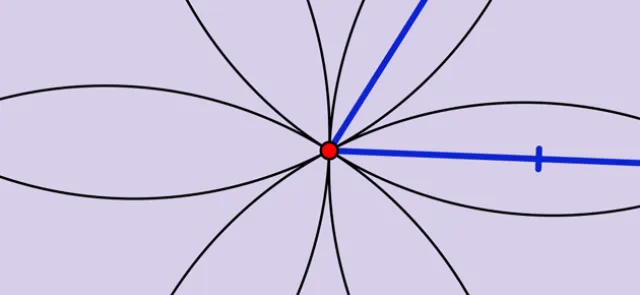
A few constructions
It is always useful to know how to construct the first constructible regular polygons with straightedge and compass. These procedures directly provide methods for calculating the various lengths in the figure.

Albert Girard, pioneer of classification | Tangente
The historian of mathematics Siegmund Günther (1848–1923) asserts that Albert Girard of Lorraine (1595–1632) had already given a general definition of the polygon in his 1626 table.

What is a polygon? A rigorous definition | Tangente
The definition of a polygon seems intuitive and obvious. Yet when we try to pin down this mathematical object more precisely, several definitions are possible, and the most recent ones may defy common sense.

Quadrilateral types and names | Tangente
For the familiar convex quadrilaterals, the classification criteria are, first, whether the sides are parallel, then whether their lengths are equal, and finally whether there are any right angles.

All about triangles: types and names | Tangente
Thanks to its simplicity, the triangle is surely the king of polygons. As its name suggests, it has three angles and therefore three sides.

Polygon names: etymology and nomenclature | Tangente
The word "polygon" comes from the Greek poly, "many", and gonos, "angle, corner", which some authors link to gonou, "knee", the body's archetypal angle.

Editorial
When our ancestors settled down, they encountered basic geometric shapes bounded by straight line segments: polygons. The Nile's regular floods thus made it necessary to develop geometric tools for reconstructing the land register, including the shape and area of cultivated fields.

The mathematicians of Père-Lachaise | Tangente
At this time of year, around All Saints’ Day, tradition calls for visits to cemeteries. So let's take the opportunity to visit the graves of mathematicians in the most iconic cemetery of all: Père-Lachaise.

Daniel Litt's probability problems
The young mathematician Daniel Litt currently holds a position at the University of Toronto. His research usually explores the interplay between algebraic geometry and arithmetic. Yet in recent months, he has attracted attention in an entirely different field, even earning an interview with the renowned online publication Quanta Magazine.

Italo Calvino's mathematical writing | Tangente
Widely read in Italian schools and universities, Italo Calvino is a major author, renowned for the literary quality of his work. He was also an avid lover of mathematics and readily drew on it in his writing, particularly to structure his texts, as one would expect of a committed Oulipian.