



Knowledge
In-depth articles on mathematical knowledge and theories

Marcia Ascher, pioneer | Tangente
Behind a wealth of research in ethnomathematics, mathematician Maria Ascher is regarded as one of the founders of this new discipline

The turtle algorithm in Vanuatu | Tangente
Mathematical modelling offers one way to make sense of Vanuatu's sand drawings. In particular, it will lead us to a surprising "turtle theorem".
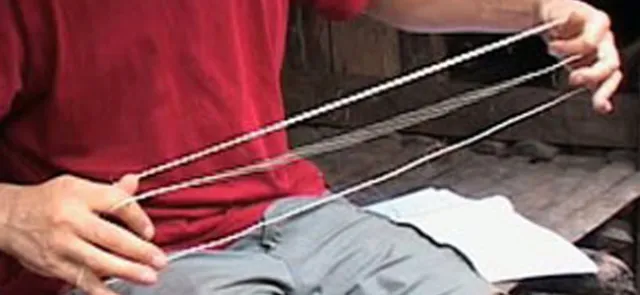
History of ethnomathematics | Tangente
Today, ethnomathematics is the study of cultural variations in mathematical practices and knowledge, particularly those developed outside scholarly and institutional settings. It offers fresh and original perspectives on mathematics and its teaching.
2024 Tangente high school students' prize | Tangente
The ninth Tangente High School Students' Prize ran throughout the 2023–2024 school year. It is a flagship initiative promoting mathematics among young people—an aim close to your magazine's heart.
2024 SMF prizes | Tangente
Every two years, the Société mathématique de France (SMF) awards the d'Alembert and Jacqueline-Ferrand Prizes.

Beyond Gauss in finance | Tangente
Gaussian curves are unsuitable for modelling risky financial assets such as stocks. To overcome this problem, Benoît Mandelbrot introduced the concept of a multifractal measure and generalized Brownian motion.
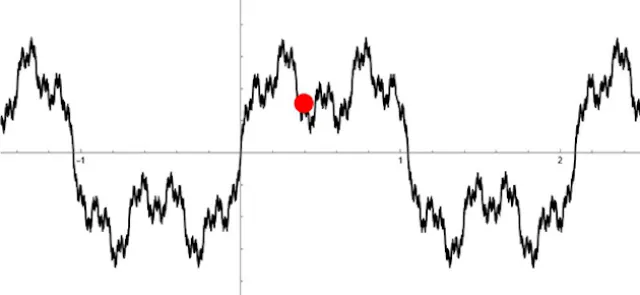
Fractal dimension
The construction of fractal objects called for new definitions of distance.

The man of fractures
For millennia, straight lines, circles, parabolas, and other smooth surfaces had reigned supreme and unchallenged over geometry. Then Mandelbrot unleashed the "mathematical monsters" of the early 20th century, transforming our picture of the world forever.

Allais and the limits of utilitarianism | Tangente
The paradox formulated by the French economist Maurice Allais exposes a contradiction in an earlier theory of decision-making. But the paradox is only apparent and, above all, illustrates a major limitation of rational choice theory.

The two-envelope paradox | Tangente
A paradox can sometimes resemble an urban legend. First, its precise origins may be difficult to pin down; second, over time it may become distorted, change form, and proliferate. Such is the case with the two-envelope paradox.
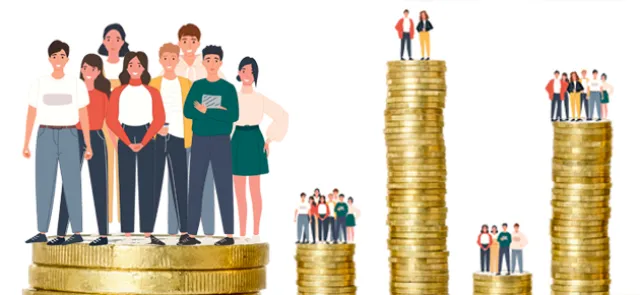
Simpson's paradox and appearances | Tangente
Could something that is true in every subgroup of a population become false when the population is considered as a whole? How is that possible? This is exactly what Simpson's paradox—the best-known paradox in statistics—shows.

The notion of paradox in mathematics | Tangente
The terms "paradox" and "paradoxical" are part of everyday language. In mathematics and logic, however, they have precise meanings that need to be clarified if we are to understand what we are talking about and what status to assign to so-called "paradoxical" results.
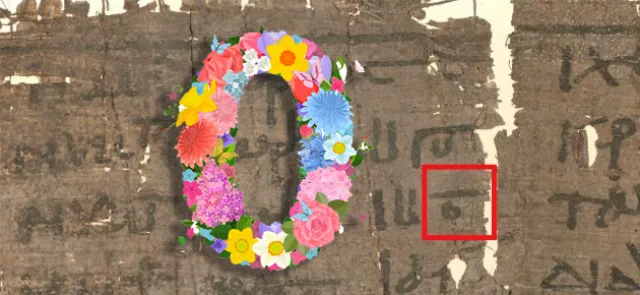
Did the Greeks use zero?
It is commonly thought that the Greeks did not know about zero. That is not entirely true: Greek astronomers had a positional zero, and Iamblichus even invented an arithmetical zero before it was consigned to oblivion.

One of them—or not…
A number for which, apparently, no definition involves a polynomial with integer coefficients has no reason to be algebraic. But that does not prove it is transcendental! Despite the many theorems on the subject, a great many numbers continue to resist classification.
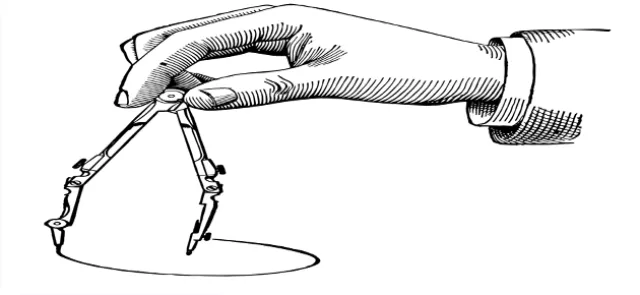
When algebra meets geometry
Some real numbers have a geometric origin: they are defined by straightedge-and-compass constructions. Although the basic idea seems simple, the properties of these numbers are not always easy to establish. This is where algebra proves indispensable.

It's everywhere!
π turns up almost everywhere, sometimes even in the most fanciful fields. In mathematics, of course, we encounter it in geometry, analysis and number theory… As a result of this omnipresence, it appears throughout the other sciences too!
The spirit of quadratic fields
Why keep adding more and more elements to the set of known numbers? Adjoining just one number to the rationals and combining it with them is already enough to produce many sets with a wealth of wonders to reveal.
New numbers with Richard Dedekind
The real numbers include the rational numbers—the quotients of two integers—and the irrational numbers, of which √2 and π are two well-known examples. This gives us one way of classifying the reals. But another classification is possible, based on numbers known as algebraic numbers.
In search of the universal number: Champernowne and Borel | Tangente
Sometimes, a concept that is relatively simple to define leads us into a world we dare not imagine, where our common sense struggles to find its bearings. Such is the case with universal numbers, which remain today as elusive as they are fascinating.

Pi, a number beyond reason
Since π is defined as the ratio of a circle's circumference to its diameter, it would be convenient if it were rational—that is, the quotient of two integers. Unfortunately, it is not! Worse still, some might say, it is even transcendental…