



Knowledge
In-depth articles on mathematical knowledge and theories

The world of functions
Many problems are tackled in function spaces, particularly those involving approximation.

Working environments for mathematicians
The abstract notion of space in mathematics is very different from what intuition suggests. Depending on the type of structure available, we can work with concepts from algebra, analysis, or geometry.
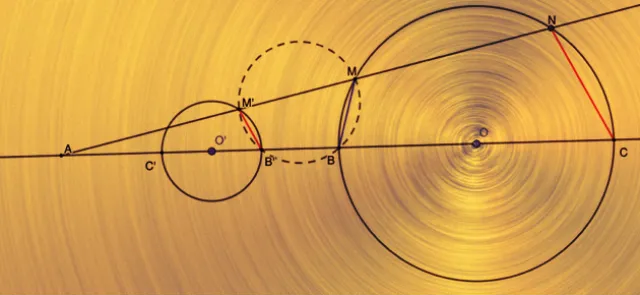
The curiosities of antiparallelism
In elementary geometry, proportionality often involves parallel lines, through the intercept theorem. But there are also antiparallel lines. Might there likewise be such a thing as "antiproportionality"?

Thales’ children
Many proofs in elementary geometry rely on proportionality. Almost all of geometry’s classic theorems involve it: Thales, Ptolemy, Menelaus, Ceva, Pappus… Here is a brief tour of these great problems.

Integer polygons
The discovery that so simple a figure as a square cannot have both sides and diagonals of integer length troubled several great scholars of antiquity. Can polygons with this property nevertheless be found? This seemingly innocent question continues to open up new avenues of research today.
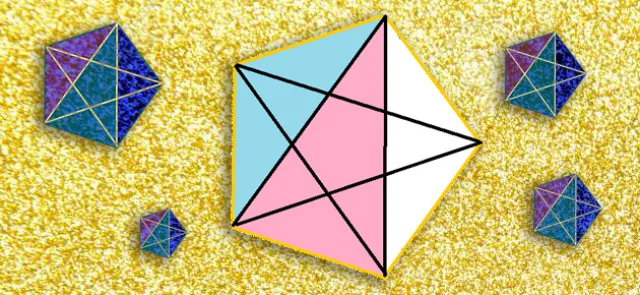
Rediscovering proportionality
Proportionality often brings to mind the rule of three—in other words, a method of calculation. Yet the concept first emerged in geometry, through the study of similar figures, a cornerstone of many theorems that gave rise to the idea of incommensurable quantities.
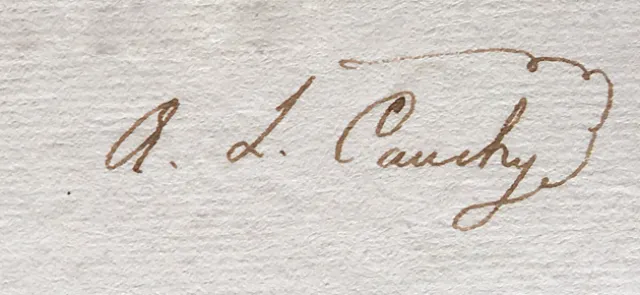
Origins of group theory: Cauchy and Galois | Tangente
Cauchy the analyst is well known; Cauchy the algebraist, much less so. Cauchy's contribution to group theory long went unrecognized, even though his research on algebraic structures was highly influential.

Inflating polyhedra
In his early work, Cauchy revived the study of polyhedra. Ever since his results on the rigidity of convex polyhedra, mathematicians have sought to learn more about more general cases. The quest has produced a new concept, the flexahedron, and a fascinating property: the bellows theorem.
A distribution like no other
Standard probability distributions can sometimes be far removed from what is observed. When extreme cases occur too often, the Cauchy distribution comes into its own.

Cauchy's rigidity theorem and polyhedra | Tangente
Cauchy's earliest work concerned polyhedra, including his foundational rigidity theorem.

Counting by substitution
At barely 25, Cauchy puts the finishing touches to a paper on symmetric functions that is eventually published as two articles. In it, he introduces new concepts, notation and methods, and creates the calculus of substitutions, which will play a central role in the development of group theory.

Cauchy and his rivals: a man of controversy | Tangente
Disputes over the authorship of theorems reflect the bitter controversies that pitted Cauchy against some mathematicians of his time.

A train of thought
It took mathematicians a long time to define a convergent sequence without falling into the many logical traps involved. Cauchy's research was among the most important contributions that eventually clarified the matter.
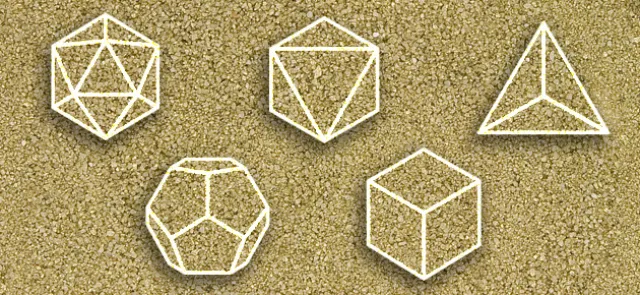
Cauchy’s first discoveries: polyhedra | Tangente
Although Cauchy is widely regarded as a highly abstract thinker, the first chapter of his work is, by contrast, strikingly visual. His study of regular polyhedra marked his entry into the world of mathematical research.

A cork on the river | Tangente
Set a cork adrift on the surface of a river. When its path is too difficult to calculate, approximation methods are the only option. Sometimes, however, the way the water flows makes the reliability of such methods problematic.
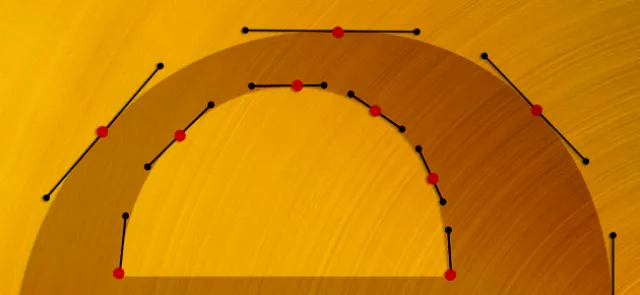
Bézier curves in modeling | Tangente
Bézier curves are particularly common in computer-aided design and can be generated easily from a small number of points that completely determine them.
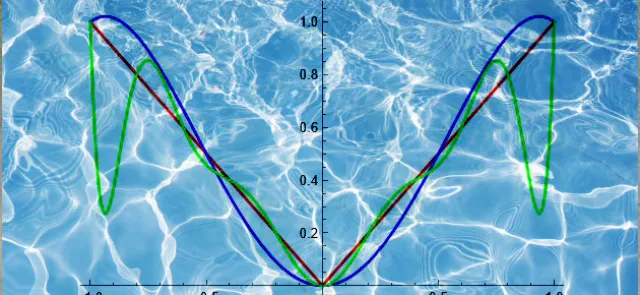
Approximating functions: not so simple...
When we want to get closer to an object, we try to reduce the distance between us and it. The same applies when "approximating" a function. But matters become more complicated because there are several notions of distance.

Approximation theory
When we do not know how to determine models or shapes directly, we approximate them using functions or curves that are easier to handle while preserving their main properties. This is the subject of approximation theory.
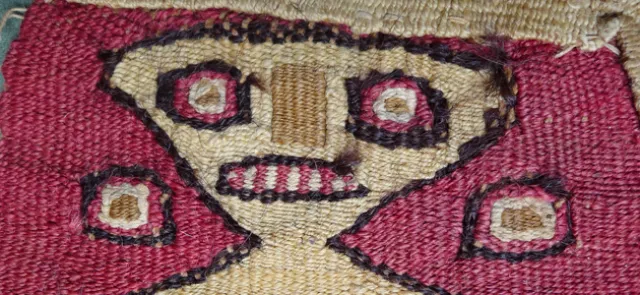
Geometry of Andean textiles | Tangente
In the Andes, weavers from periods sometimes lost in the distant past produced an immense variety of patterns that nevertheless bear a clear family resemblance. Mathematics can help us understand part of the visual language these textiles share.

Combinatorics on words and music | Tangente
Combinatorics on words is an area of mathematics that has proved particularly fruitful for studying certain musical phenomena, especially the rhythmic features of African and Malagasy music—so much so that a computer can even recreate them!