



Maths and art
Intersections between mathematics and artistic expressions: music, painting, architecture, design

Tangente's 35th anniversary | Tangente
Come celebrate a unique anniversary, the 35th anniversary of the only magazine of mathematical culture in the world sold at newsstands! There will be something for every taste, every age and every level. Here is a preview of what this eventful day has in store. The full program can be found at the end of this article.

H.S.M. Coxeter: A geometer's long life | Tangente
H.S.M. Coxeter was born on February 9, 1907, in Kensington, Great Britain. Since both his parents were art lovers, music became his first passion.
Origami in robotics and medicine | Tangente
No, this is no longer science fiction: origami-inspired minirobots can now deliver medication exactly where it is needed in the human body.
The Demaines: a father-son duo passionate about folding | Tangente
Born in 1942, Martin Demaine initially studied glassblowing in Britain.
Origami crease patterns: the geometry of folding | Tangente
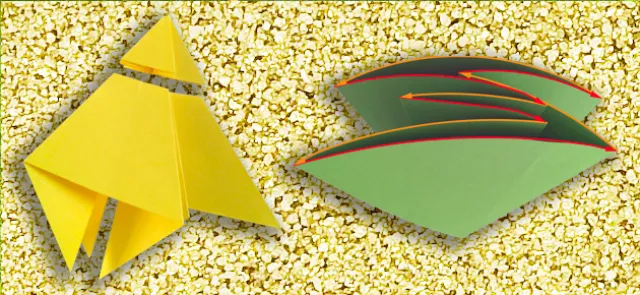
Studying the geometric figures obtained by fully unfolding an origami creation has led to general theorems that can be stated simply. These results quickly lead to questions connected to major open problems in mathematics.
David Huffman, curved-fold origami pioneer | Tangente
Some artists' origami sculptures are often impressive, whether for their striking representational qualities, their painstaking detail, or their particularly pleasing geometry.
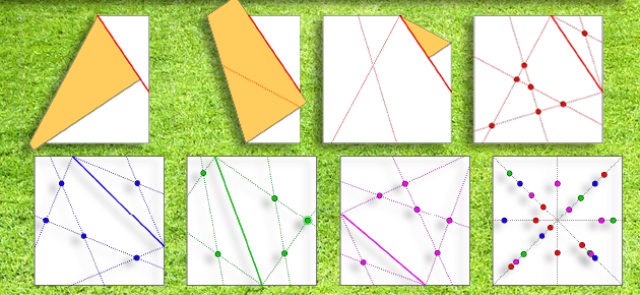
A wealth of constructions
Some constructions impossible to achieve with straightedge and compass become possible using origami… but not all of them! Paper folding also lets us revisit several questions of concurrency or collinearity, and reflect on the construction of polygons.
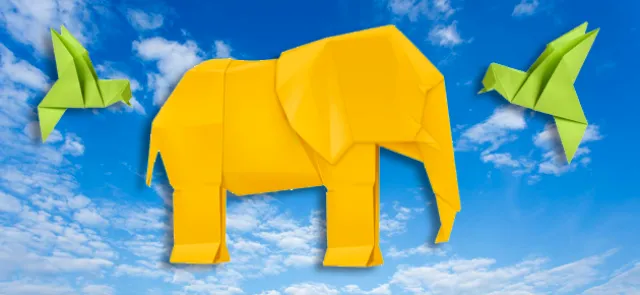
Folded paper and origami: many uses | Tangente
Paper is a material of choice for many artists. The art of folding takes several forms.
History and theory of origami and paper folding | Tangente
Historically, the art of paper folding is thought to have emerged in China as early as the 2nd century BCE. Wherever it developed, the practice seems to have been closely linked to the advent of paper.
The Haga fold
Straightedge-and-compass geometry boasts a long history. But Euclid and his followers do not have a monopoly on points, lines and figures! The study of origami geometry is more recent, and it is surprisingly effective. Kazuo Haga has shown just how much richness a simple fold can hold.
Bertrand Russell's politically engaged writings | Tangente
Bertrand Russell's literary writings range widely; they are tinged with philosophy, politics, and sociology. What unites them is that they all have a message to convey.
The Möbius strip in art | Tangente
The legendary Möbius strip—a two-dimensional, non-orientable surface with only one side, easily made from a strip of paper—has inspired several artists.
Galois's handwritten papers at Louis-le-Grand | Tangente
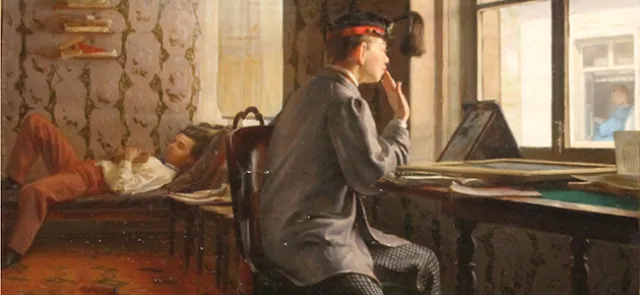
Although Galois's "complete" works were published in 1962, they can be "completed"—a kind of paradox of completeness—with his papers from the 1829 entrance examination for the École préparatoire. They are held in the Archives nationales. Let us open them! Some of them have never been published.
Maths enthusiasts take the stage | Tangente
Maths in the theatre—can that really be serious? Absolutely! From the maths teacher at the blackboard, embodying abstract mathematics before their students, to the actor on stage playing an imaginary character, it may be only a short step—one that many enthusiasts have taken. And in this field, imagination reigns supreme, so anything goes!
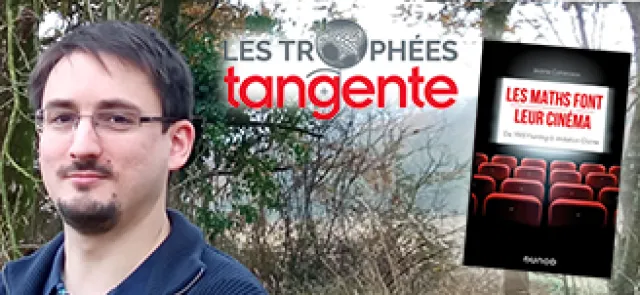
Tangente Awards 2021: the winners | Tangente
As it does every year, the Tangente Awards ceremony was a highlight in the promotion of mathematics and the role literature plays in it. After the 2020 event was held remotely, the 2021 ceremony took place in person on December 16 at the Musée des Arts et Métiers. Meet the award-winning works and their authors.
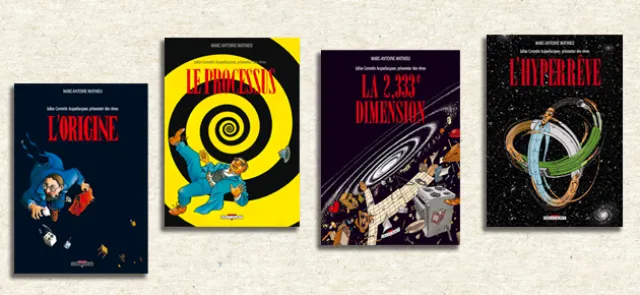
Marc-Antoine Mathieu: comics and dimensions | Tangente
Julius Corentin Acquefacques, prisoner of dreams, is perhaps the comic-book hero most often drawn into the world of mathematical ideas. Let's venture into the extraordinary world of his creator, Marc-Antoine Mathieu.
Rose Polymath and Anselme Lanturlu: Science comics | Tangente
Many comic-book authors draw on mathematics in their work, whether consciously or not. Conversely, scientists committed to public outreach who can also draw sometimes try their hand at making comics.
Donald in Mathmagic Land: finally in comic-book form | Tangente
Donald in Mathmagic Land (Hamilton Luske, 1959) is a 27-minute short film produced by Walt Disney Studios.
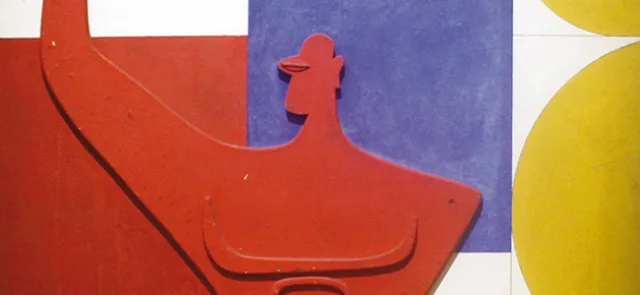
An architect's dream?
The golden ratio, as everyone knows, crops up everywhere in art... provided, that is, you are determined to find it and willing to overlook (!) a few approximations or anachronistic units of measurement. Let's trace the writings that linked it to architecture and brought it to public attention.
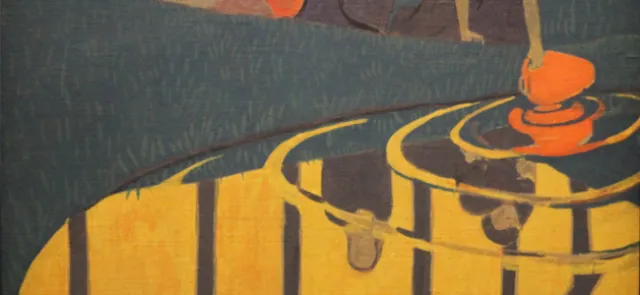
Golden ratio in art: between myths and realities | Tangente
However you look at the paintings, it is hard to substantiate the idea that the golden ratio's presence in art gives a work some decisive aesthetic quality. Let's see where φ really lurks...