



Math for everyone
Mathematical content accessible to everyone
 Podcast
Mirzakhani: thinking in pictures | Tangente
Even before her research career began, Maryam Mirzakhani started filling small notebooks with drawings of imaginary surfaces resembling fantastical worlds. Some of these sketches, which she found "simply beautiful," inspired several of her works in topology.
 Podcast
Maryam Mirzakhani, from Tehran to Stanford | Tangente
A brilliant, passionate young woman, Maryam Mirzakhani turned her curiosity into an exceptional scientific career. Her optimistic outlook and perseverance changed the place of women in a field long dominated by men. Her life, brief but luminous, continues to inspire.
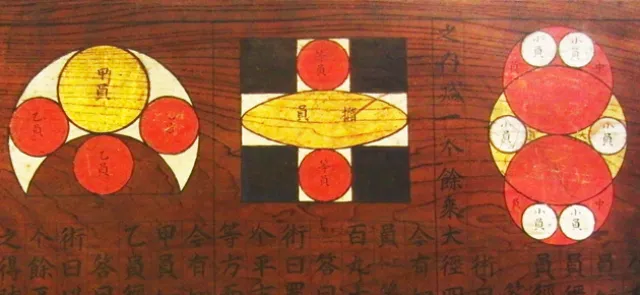
Sangaku: geometry in Japan's temples | Tangente
Sangaku are a remarkable practice, bringing together mathematics, art and spirituality. They offer a precious glimpse into the mathematics practiced during the Edo period and give a sense of how sophisticated popular mathematical culture was at the time.
 Podcast
How division was done in China
Once a polynomial equation is given, its roots can be found simply by applying a division algorithm. This algorithm is based on the process of division. Here are its main principles.
 Podcast
Counting in Chinese: numeral systems and counting rods | Tangente
The Chinese numeral system dates back to the beginnings of written Chinese, around the third millennium BC.
 Podcast
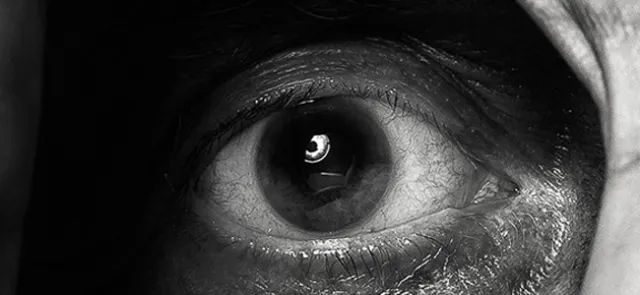
Making art with the Conway knot | Tangente
An artist passionate about mathematics, Michel Delaunay creates works that plunge the eye into the infinity of geometric and topological aesthetics. He notably combines the potentialities of the cube with those of the Conway knot.
 Podcast
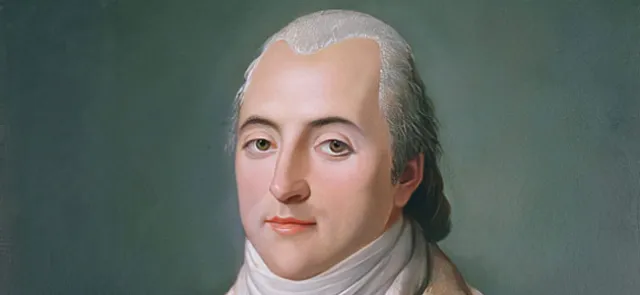
Saint-Simon's dream of a mathematized... | Tangente
In 1820, Saint-Simon proposed a complete reorganization of political life in which he imagined handing power to mathematics. Although his project was never implemented, it directly influenced the emergence of technocracy and our conception of expertise in politics.
 Podcast
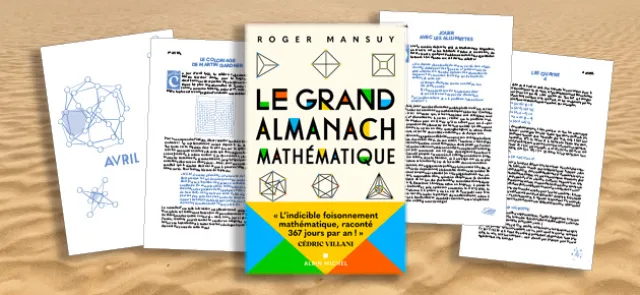
Roger Mansuy's mathematical almanac | Tangente
On the occasion of the publication of his Grand almanach mathématique (The Grand Mathematical Almanac), Roger Mansuy opens up to Tangente about the secrets of this book like no other, in which readers discover, among others, many unjustly forgotten figures.

In real life | Tangente
In physics as in architecture, parabolas often appear, whether to model phenomena or provide inspiration.
 Podcast
Celestial parabolas | Tangente
Imagine the Solar System as a collection of different bodies—planets, comets…—subject only to the Sun’s gravitational pull. Classical mechanics then tells us that their orbits can trace only three types of curve: ellipses, hyperbolas and parabolas.
 Podcast
Straightening the curve
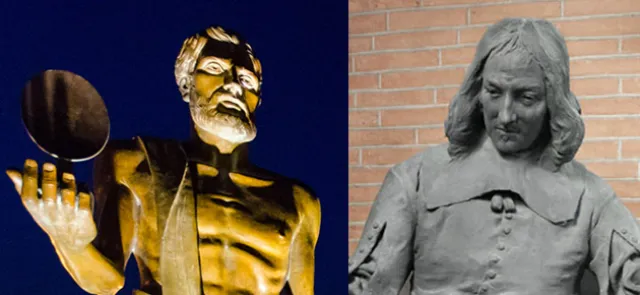
The quadrature of the parabola was one of the first triumphs of ancient geometry in the study of areas bounded by curved lines — a success wrested through fierce struggle by Archimedes, before more modern methods simplified and generalized the result.
 Podcast
Tangents and the parabola: gems galore
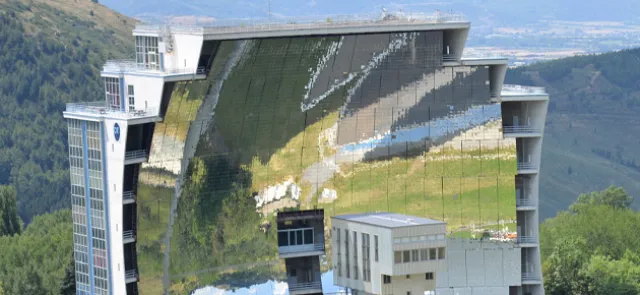
Behind its sleek appearance, the parabola brims with fascinating properties. Thus, the study of its tangents reveals remarkable angular properties and offers a playground of astonishing richness, where classical geometry meets luminous reflections.
From Pascal to Poncelet
In the winter of 1812, the retreat from Russia ended in disaster. Jean-Victor Poncelet (1788–1867), a 24-year-old military engineer, was taken prisoner. Steeped in Gaspard Monge's (1746–1818) descriptive geometry, he laid the foundations of modern projective geometry in the prison camps of Saratov, without books or instruments.
 Podcast
Constructing a parabola | Tangente
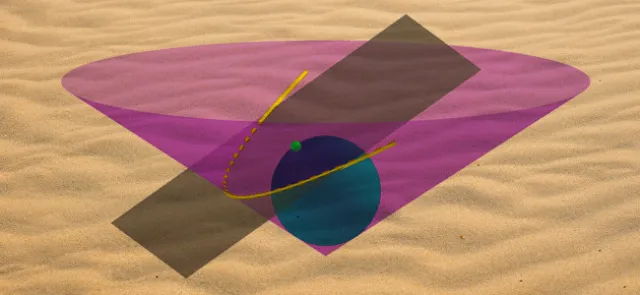
Constructing a parabola is both fun and highly instructive. It brings its geometric properties to life and even provides an opportunity to do some arithmetic.
 Podcast
A line, a point, that's all | Tangente
The parabola is one of the simplest curves to define, yet also one of the richest, with properties that make it a flagship object in classical geometry as much as in algebra and analysis. It thus offers an opportunity to bring together different mathematical perspectives.
 Podcast
Misleading graphical proofs: the missing square paradox and more
Discover how seemingly rigorous diagrams can fool us: the missing square paradox, the astonishing proof that every triangle is equilateral, and more.
 Podcast
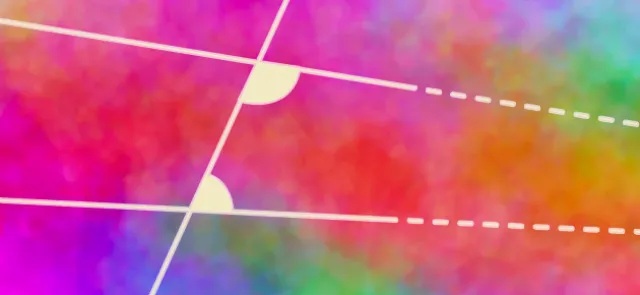
When Legendre believes he has proved the fifth postulate
For two millennia, mathematicians sought to prove Euclid's fifth postulate. Adrien-Marie Legendre believed he had found a proof, before realizing that his proof implicitly assumed the truth of that same postulate. A circular argument…
 Podcast
Misunderstanding Indian numerals | Tangente
Indian numerals passed through Islamic lands as early as the eighth century (see Tangente special issue 93), then naturally made their way to Spain. There was just one problem: in the medieval West, zero was systematically left out! This failure to grasp the decimal positional system would cause a delay of a good century and a half…
 Podcast
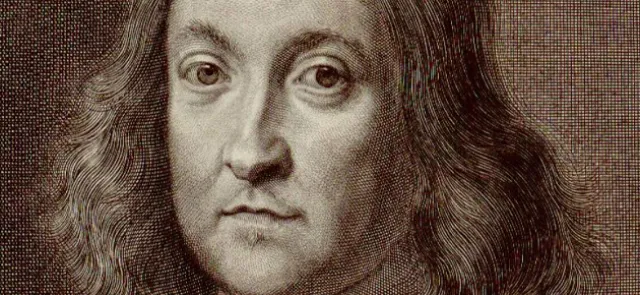
Fermat's false theorem
Fermat formulated many theorems, but one of them proved false: he conjectured that all "Fermat numbers" were prime, an error exposed by Euler. This notably illustrates how induction can lead us astray.

Math games: 2048 and more | Tangente
All right… a little screen time after all—not to do the arithmetic for us, but to practise mental arithmetic while having fun. The games featured on this page can be downloaded to a smartphone.