




L’objet principal de la microéconomie est l’analyse de décisions individuelles concernant les biens et les services, dans le but d’en déduire des lois générales qui pourront ultérieurement être confrontées à la réalité sur le terrain. Dans de nombreuses situations, les problèmes rencontrés peuvent être résolus graphiquement en invoquant le concept de tangence et cela sous différentes formes. Trois exemples microéconomiques classiques permettent de l’illustrer : la théorie de base du producteur ou du consommateur fait intervenir des droites tangentes à des courbes, la boîte d’Edgeworth utilise des courbes tangentes entre elles, et le coût moyen à long terme d’une entreprise se traduit graphiquement par une enveloppe d’une famille de courbes.
Droites tangentes à des courbes
La notion de droite tangente à une courbe est souvent utilisée en microéconomie. D’un point de vue mathématique, certains problèmes économiques consistent à rechercher l’optimum pouvant être atteint par un certain objectif à plusieurs variables, toutes éventuellement soumises à des contraintes. Considérons le cas (simple) de la recherche d’un maximum d’une fonction à deux variables supposées positives ou nulles et vérifiant une vraie contrainte donnée par une inégalité du premier degré. Les problèmes de base dans les théories de la production ou de la consommation sont de ce type. Formellement, ils sont en tous points analogues, seuls diffèrent les notations et le vocabulaire utilisés, conformément au tableau d’équivalence ci-dessous.
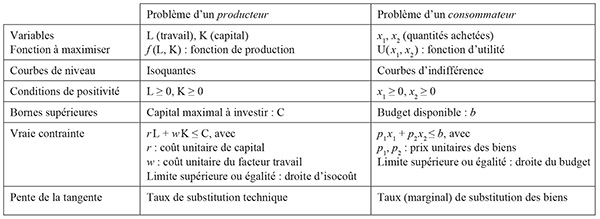
La notion de courbe de niveau mérite d’être détaillée. Ainsi, une isoquante est la courbe prenant en compte les variables capital et travail permettant de parvenir à un degré égal de niveau de production. Une courbe d’indifférence reprend l’ensemble des paniers offrant même satisfaction au consommateur. Toute courbe de niveau prend la forme d’une fonction décroissante à concavité « vers le haut ». Le choix optimal pour atteindre le maximum recherché est situé en un point où une courbe de niveau de l’objectif est tangente à la droite dont l’équation est obtenue en convertissant en égalité l’inégalité de la vraie contrainte. En ce point de tangence, la pente de cette droite coïncide donc avec ce que l’on nomme le taux marginal de substitution, qui mesure le taux auquel une variable doit être substituée à l’autre pour maintenir le même niveau optimal de l’objectif. La courbe qui relie les points optimaux, lorsque la droite définie par la contrainte se déplace parallèlement à elle-même, intéresse particulièrement les économistes. On parle ici de chemin (ou sentier) d’expansion.