Fractions of fractions, full speed ahead
A very simple way of constructing a sequence of fractions can lead to surprisingly deep mathematical tools. Here is an example that leads to the famous Prouhet–Thue–Morse sequence and its many applications.

A very simple way of constructing a sequence of fractions can lead to surprisingly deep mathematical tools. Here is an example that leads to the famous Prouhet–Thue–Morse sequence and its many applications.

Articles recommended for you.

The Morse word, or Prouhet–Thue–Morse sequence, is an easy-to-construct mathematical object with plenty of surprises in store. Join us in exploring a combinatorial sequence that would certainly deserve to be every bit as famous as Fibonacci's!

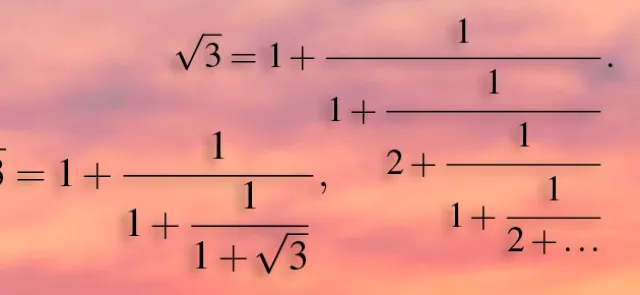
There are other ways to represent real numbers besides our decimal notation! One of the best known is to write a number as a continued fraction. The resulting representations, even when truncated, very quickly provide "good" approximations of the original number.

Adding several fractions always produces another fraction. But when the sum continues indefinitely, things are very different. If chosen carefully, such sums can approximate numbers like π and yield a wealth of fascinating, unexpected results.

Why go to the trouble of finding equivalents for seemingly well-behaved functions? To gain detailed insight into local or asymptotic behavior—and for applications, too! Without these techniques, even spreadsheets would be unable to perform seemingly innocuous calculations.
Discussion
Sign in to post a comment and talk with other readers.
No comments yet. Be the first to respond.