


Les sciences physiques ont vocation à expliquer, voire à prévoir les phénomènes naturels. L’observation de ces derniers peut suffire à s’émerveiller. Leur explication remplit de satisfaction. Leur prédiction illumine… ou affole. Une autre source d’étonnement continu réside dans la formidable adéquation entre les mathématiques – qui ont leur vie propre – et la physique. Cette fructueuse rencontre entre les deux disciplines peut se faire à travers leurs courbes et leurs trajectoires. Comment une même courbe permet-elle de décrire des mouvements d’objets aussi divers que des particules électriquement chargées ou des planètes ? Comment un sinus peut-il si bien rendre compte des chemins empruntés par la lumière ?
Particules, projectiles et planètes
En sciences physiques, les coniques décrivent toutes les trajectoires… ou presque ! Que l’on modélise une planète ou une comète gravitant autour d’une étoile, un projectile peu soumis à des frottements, ou bien une particule chargée s’approchant d’une autre ou se déplaçant dans un champ électrique uniforme, la trajectoire obtenue est une conique.
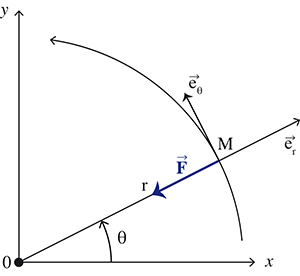
Toute interaction mécanique modélisable par une force centrale est susceptible de conduire à une trajectoire elliptique, parabolique ou hyperbolique. On qualifie ainsi les forces dont la direction est la droite passant par les centres des deux objets O1 et O2 en interaction, c’est-à-dire du type où est un vecteur directeur de la droite (O1O2). En fait, est aussi un vecteur de la base polaire attachée à l’un des objets étudiés (au point M) et centrée sur l’autre avec lequel il est en interaction (en O). C’est le cas de la force de gravitation entre deux masses et de la force électrostatique entre deux charges électriques.