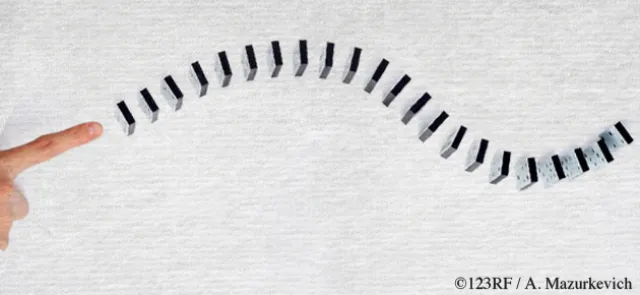




Selon Poincaré, le raisonnement par récurrence est l’exemple parfait du raisonnement qui caractérise les mathématiques ; il permet de franchir le pas entre le fini et l’infini. Supposons définis le nombre 1 et l’opération qui, à un nombre entier x, associe x + 1. Il est alors facile de définir la somme de deux entiers x et y. On démontre ensuite les propriétés de l’addition, associativité puis commutativité : on montre que, par exemple, x + 1 = 1+x puis que, si pour un entier y, on a x + y = y + x, alors on a encore x + ( y + 1) = ( y + 1) + x, donc on conclut que, pour tout y, x + y = y + x.
Mais quelle est la nature exacte du raisonnement par récurrence ? Est-ce le seul raisonnement utilisé pour démontrer les propriétés de l’addition ? Est-ce un axiome de la logique, ou une simple définition ? Poincaré mènera une réflexion profonde sur ces questions, qui restent d’actualité, surtout dans l’enseignement des mathématiques : à côté de la géométrie, l’arithmétique y tient une place centrale.