



Everyday Math
Applied mathematics to everyday life: elections, sport, music, road traffic, weather, computer science, finance
 Podcast
Two billion smartphones turned into a seismograph network
Explanation of the Android earthquake alert system that turns the accelerometers of two billion phones into an early earthquake detection network.
 Podcast
2026 World Cup: 25,000 simulations pick Spain to win
Using 25,000 simulations and the Monte Carlo method, Opta predicts Spain will be 2026 world champion with a 16.1% chance. But this figure illustrates the paradox of 48-team tournaments: even the top favorite has an 84% chance of not winning.
 Podcast
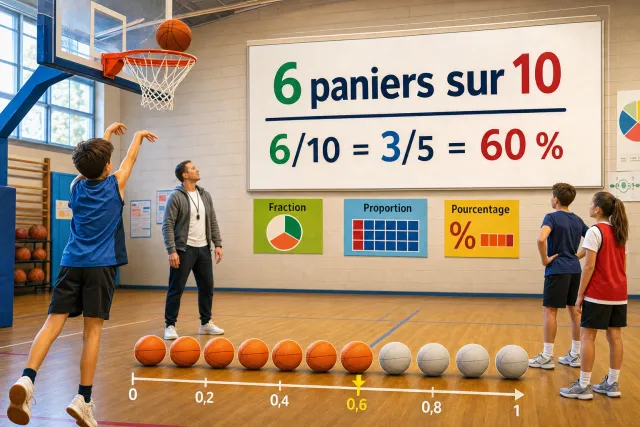
Can you learn fractions by shooting a basketball?
A Norwegian study demonstrates that basketball exercises help students aged 11 to 13 improve by 15% in fractions, thanks to learning through the body.
 Podcast
Gothic cathedral symmetries: the mathematics of the Middle Ages
Discover how Gothic architects mastered symmetry to create geometric masterpieces in cathedrals, with orders of symmetry as high as 8.
 Podcast
Year 2038 bug: the 32-bit timestamp problem explained
A massive bug related to the way computers represent large numbers looms on January 19, 2038, at 3:14:08 a.m.
 Podcast
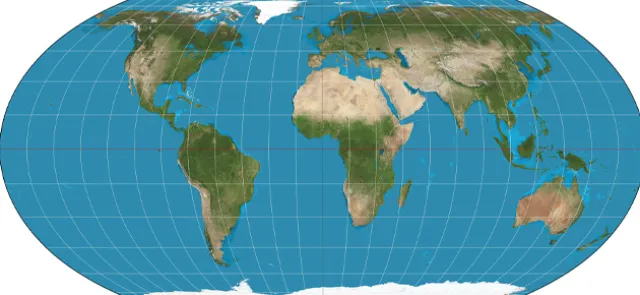
Mercator projection: anatomy of a geopolitical map
We tend to think of mathematics as a perfectly neutral science. Yet, like any human construct, its uses can prove more political than they appear. That is how an age-old geometry problem found its way into diplomatic debates in recent months.
 Podcast
Long and short scales: billion, trillion, milliard—how to name large numbers
From colossal fortunes to the limits of mathematical language, words struggle to keep pace as numbers explode. From long and short scales, through international conventions, to mathematicians' bold inventions, the way we name extremely large quantities tells a story in which language, science and imagination meet.
 Podcast
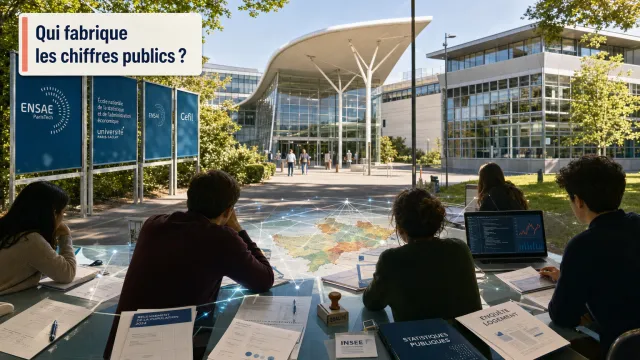
Training Insee staff: ENSAE, ENSAI and Cefil
Insee trains its staff at three schools with admission by competitive examination: ENSAE, ENSAI and Cefil. Their multidisciplinary programs in statistics, economics and computer science prepare students for data careers.
 Podcast
Insee surveys: methods and the challenges of official statistics
Discover how Insee rigorously conducts its statistical surveys, from sampling to estimating unemployment.
 Podcast
How are statistical data collected in France?
Official statistics are governed by strict rules for surveys. Discover the institutions involved, multimode data collection and the biases inherent in each method.

Narcissistic numbers and their secrets | Tangente
In the 1960s, while teaching at the University of Rochester in New York State, Mike Armstrong became particularly interested in k-digit numbers equal to the sum of the kth powers of their digits.
 Podcast
The magic wand theorem | Tangente
Maryam Mirzakhani is also known for having obtained, with Alex Eskin and Amir Mohammadi, the magic wand theorem, so named because it made it possible to solve at a stroke many previously inaccessible problems. To explain it, let's first delve into translation surfaces. The illumination problem is one of its many applications.
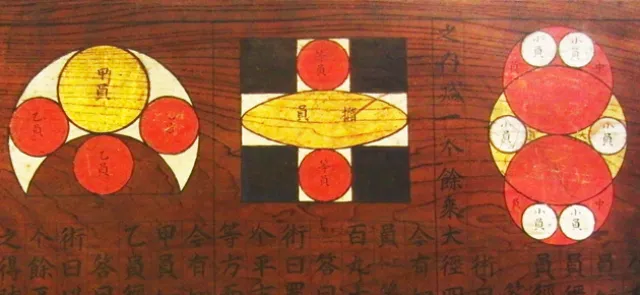
Sangaku: geometry in Japan's temples | Tangente
Sangaku are a remarkable practice, bringing together mathematics, art and spirituality. They offer a precious glimpse into the mathematics practiced during the Edo period and give a sense of how sophisticated popular mathematical culture was at the time.
 Podcast
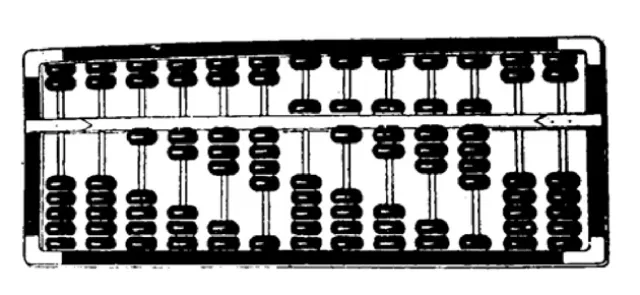
Spread of Chinese math practices, 13th–16th c. | Tangente
The abacus was not the only practical mathematical tool to have existed in China. Concise formulas also made it possible to calculate very quickly. These tools enabled the spread of knowledge over the centuries, thanks to numerous treatises explaining their mechanism.
 Podcast
Chinese science history: an awakening interest | Tangente
At the end of the sixteenth century, contact with knowledge and practices from Europe changed the way mathematics was perceived in China, both from a technical and a historical point of view, around two major questions: how should it be practiced, and who invented it first?
 Podcast
Why study Chinese mathematics? | Tangente
The history of mathematics in Asia is marked by the central place occupied by China, as a producer of both knowledge and institutions for teaching the sciences. Both were, in the past, taken up by other countries in East Asia. Several of the mathematical classics developed in China were studied elsewhere and inspired the mathematical knowledge and practices implemented there.
 Podcast
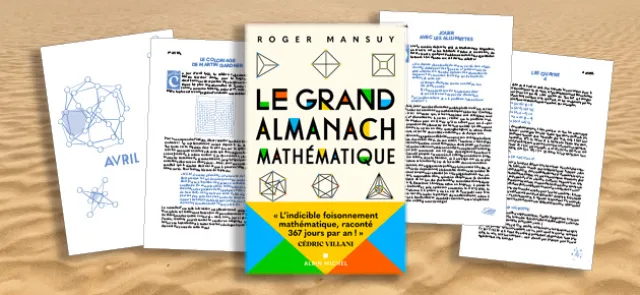
Roger Mansuy's mathematical almanac | Tangente
On the occasion of the publication of his Grand almanach mathématique (The Grand Mathematical Almanac), Roger Mansuy opens up to Tangente about the secrets of this book like no other, in which readers discover, among others, many unjustly forgotten figures.
 Podcast
Misunderstanding Indian numerals | Tangente
Indian numerals passed through Islamic lands as early as the eighth century (see Tangente special issue 93), then naturally made their way to Spain. There was just one problem: in the medieval West, zero was systematically left out! This failure to grasp the decimal positional system would cause a delay of a good century and a half…
 Podcast
At Ratchinski's public school
For fifteen years, Sergei Ratchinski developed his own teaching method, based on creativity.
 Podcast
Fermi's wacky problems
They contain no data, yet a little ingenuity and plenty of common sense are all you need to work them out in your head: welcome to the world of the wacky problems invented by physicist Enrico Fermi.