



History and Culture
History of mathematics and cultural connections
 Podcast
The marquise and the scholars of her time | Tangente
Among masters and peers alike, the marquise may have been unique for her sex, but she was not alone, as her many intellectual exchanges with the scholars of her time attest: Maupertuis, Clairaut, Euler, Kœnig, Johann II Bernoulli, Cramer, among many others.
 Podcast
Émilie du Châtelet: From shadow to light | Tangente
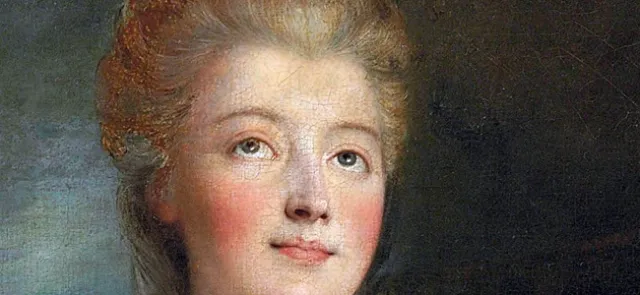
As a learned woman, Émilie du Châtelet sometimes found herself overshadowed by men, beginning with Voltaire. Yet her intellectual freedom allowed her to shine and win genuine recognition.
 Podcast
Émilie du Châtelet, learned philosopher | Tangente
Émilie du Châtelet is often presented as the translator of Newton and the woman who introduced Leibniz's and Wolff's thought to France. On that view, she would be no more than a translator and a popularizer. In reality, she is far more than that: she is above all a scholar and a philosopher.
 Podcast
Order according to Ramsey
Ramsey theory is another field in which Erdős played a crucial role without being its originator. His use of the probabilistic method was essential to this theory, whose aim is to find the size of a set that guarantees the existence of a substructure possessing a given property.
 Podcast
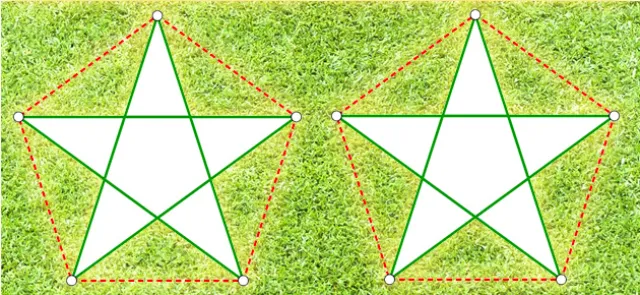
A happy ending
Behind this phrase lies a famous mathematical challenge that brought together two brilliant minds on a quest to uncover the hidden order within chaos. It was the birth of a beautiful love story — and of a new branch of mathematics!
 Podcast
A cornucopia
Paul Erdős and Leonidas Alaoglu studied highly abundant and superabundant numbers, rediscovering along the way notions already studied, but not published, by the celebrated Indian mathematician Ramanujan.
 Podcast
Some of Erdős's work in number theory
Analytic and probabilistic number theory was one of Paul Erdős's favorite subjects. Here is a small selection of his contributions in this field, picked here and there from topics that can still be presented accessibly.
 Podcast
Trinity College and the dissection of the square | Tangente
In the 1930s, the problem of dissecting a square into smaller squares of different sizes gave rise to two conjectures by Erdős. They would be disproved by four Trinity College students who threw themselves into the research.

Two geometric jewels
Long after the 19th century, the golden age of geometry, Erdős took an interest in problems whose statements could appear in an elementary textbook. Among these are two jewels of elegance: the Erdős–Mordell theorem, which involves nothing more than a triangle, and the Erdős–de Bruijn theorem, which features only points defining lines.

Some conjectures in algebra
Here are a few conjectures proposed by Erdős that, despite some progress, remain unsolved...

Paul Erdős by George Csicsery — Documentaries | Tangente
 Podcast
The great book of problems
The "Book" was a project of Erdős's to bring together the most beautiful known mathematical proofs, several of which had been found by Erdős himself. Although he died shortly before the project was completed, the work was nonetheless published, authored by Aigner and Ziegler. Its successive new editions keep the flame alive.

Friends to count on — Graham, Chung and Erdős | Tangente
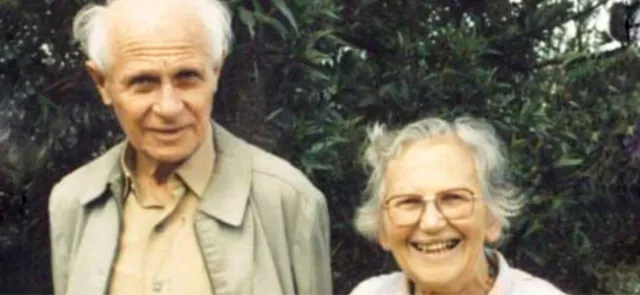
The married mathematicians Fan Chung and Ronald Graham were among Paul Erdős's closest friends. They took care of some of the practical aspects of Erdős's itinerant life.
 Podcast
Collaborating with Paul Erdős — Tenenbaum's Account | Tangente
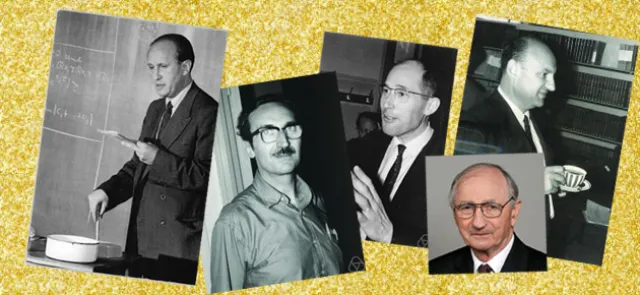
Much of Paul Erdős's work was carried out jointly with others. Gérald Tenenbaum, one of the French mathematicians who collaborated with him, agreed to discuss the methods of this unconventional mathematician.
 Podcast
The weaver mathematician — the Erdős number | Tangente
Fostering mathematical collaboration like no one else at a time when doing so was not as easy as it is today, Paul Erdős prompted a new way of looking at publications: first as a marker of ties to him, then as a subject of study in its own right.
 Podcast
Erdős and old age — humor and self-mockery | Tangente
A few years before turning sixty, Erdős began adding strange initials to his signature as a reminder of the passage of time.

Paul Erdős: Biographies and a film | Tangente
Two books in particular, both published in 1998, offer a glimpse into Erdős's life through anecdotes and accounts by other mathematicians.
 Podcast
To exist is to do mathematics — Erdős | Tangente
Pál Erdős (1913-1996) is renowned for his eccentric behavior, but above all for the brilliance of his ideas. His ingenious methods, off the beaten track, his countless publications, and his constant wandering built the image of a legendary scholar.
 Podcast
More than 600 problems still open
Throughout his life, in papers written either alone or with collaborators, Erdős posed a great many problems. He solved some of them—but far from all.

An iconic photograph
The famous photograph of Paul Erdős and Terence Tao deep in thought has become an iconic image in the recent history of mathematics. But what were these two extraordinary minds thinking about at that moment?