



Math for everyone
Mathematical content accessible to everyone

The haberdasher's puzzle and Dudeney's puzzle
Any polygon can be cut into finitely many pieces and rearranged to form any other polygon of the same area. This property holds in the plane, but its three-dimensional counterpart is false. It was conjectured by the Hungarian mathematician Farkas Bolyai (1775–1856).

Euler's 36 officers problem | Tangente
In 1779, while the Swiss mathematician Leonhard Euler was at the court of Catherine of Russia, she asked him to investigate a problem that had been circulating in Saint Petersburg for some time, but that no one had managed to solve.

Sylvester's problem | Tangente
In 1893, the British mathematician James Joseph Sylvester (1814–1897) posed the following question in the Educational Times.
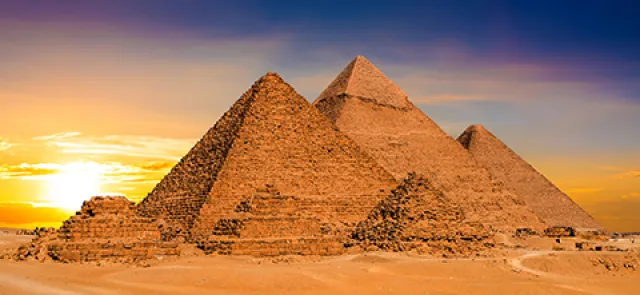
The mystery of the little pyramids
The triangle is undoubtedly one of the simplest figures in the plane, and its geometry is well understood. In three dimensions, however, the study of tetrahedra remains an active field full of surprises! One problem has just been completely solved, more than forty years after John Conway and Antonia Jones first posed it.
Martin Gardner's challenge: paradoxes | Tangente
Can a game in which one player's gain is the other's loss benefit both players? That was the question Martin Gardner posed in 1980 with his "Loser Takes All" problem. More than forty years on, the paradox remains as relevant as ever!
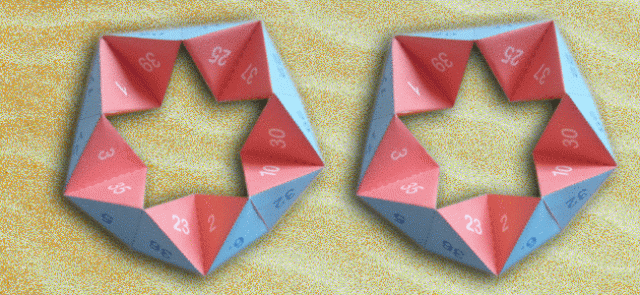
The magic ring of tetrahedra | Tangente
Details on how to build the ring of tetrahedra that you can cut out from the pull-out section of Tangente 200. An explanation of how the numbers on its forty faces were chosen, using a rule that generalizes the concept of a magic square.

Collective decision-making and mathematics | Tangente
Arrow's classic impossibility theorem has often been invoked in political theory to demonstrate the irrationality of democracy. But is this result truly relevant to political science? Let's also revisit some of the mathematical arguments used in the epistemic theory of democracy.

Friendship among numbers | Tangente
In mathematics, being amicable is not the same as having friends...

200, a number like no other!
It can be written as a numeral, 200, or in words, two hundred. Even so, at first glance, the number does not seem particularly interesting. Admittedly, it is not perfect, unlike the eponymous issue of Tangente, but, like Achilles, it is powerful... and therefore fascinating. Here is a brief survey of its arithmetic properties.
Napoleon's problem
In this bicentenary year of 2021, let's revisit a result that bears his name. The emperor is said to have had a keen interest in geometry; according to one story, he once discussed the subject with two mathematicians of his day, Joseph Lagrange (1763–1813) and Pierre-Simon Laplace (1749–1827).
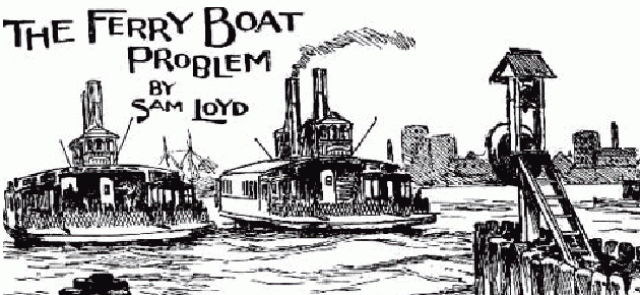
Elegant problem-solving methods
The appeal of recreational mathematics is that it requires little formal knowledge. Yet there are ingenious techniques that are hardly ever taught.
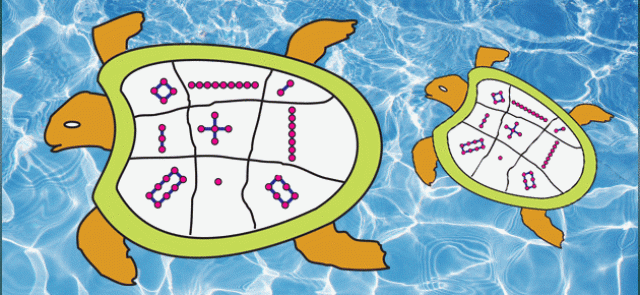
Timeless mathematical puzzles | Tangente
Puzzles have been part of human culture since earliest antiquity. At first, inventing puzzles was bound up with mythology or religion; gradually, it became a purely intellectual game, independent of any purpose or practical application.

Computer geometry: Cabri and GeoGebra | Tangente
Although computer drawing had been possible since the 1970s, so-called "dynamic geometry" software did not become widespread until the 1980s.

Compass: a universal instrument | Tangente
Compasses are made of wood or metal, in all sizes, with or without a sector.
Drawing a circle: a geometric challenge | Tangente
During the last lockdown, travel in metropolitan France was restricted to within 10 km of the address where people were staying during that period. Now there is a rule guaranteed to pique the curiosity of mathematics enthusiasts!

Give Euclid his due...
Geometric constructions are central to reasoning in Euclid's The Elements. The various methods of teaching geometry, right up to the present day, claim to follow this approach.
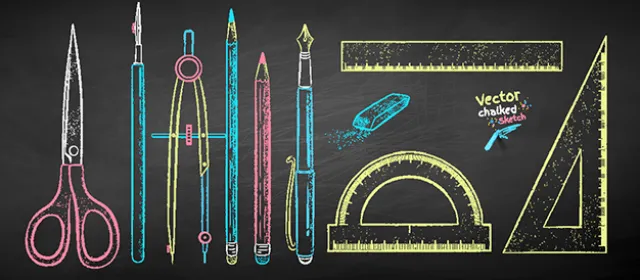
Why a sound method matters in geometry | Tangente
Never known how to "get started" on a straightedge-and-compass geometry problem? What matters, which points should you introduce, and which line should you construct? The classic, tried-and-tested method of analysis and synthesis provides a sound approach to such construction problems.
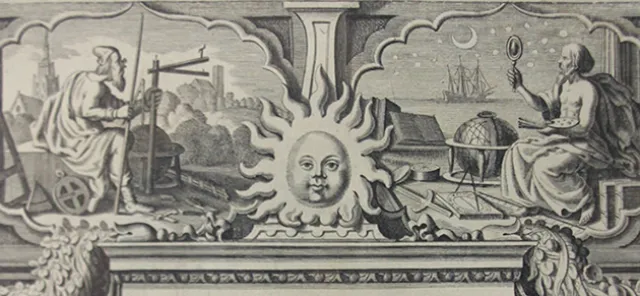
Through Euclid's eyes
Two postulates in Euclid's Elements embody the ideal conception of the straightedge and compass inherited from Plato's realm of Ideas. The Alexandrian scholar built much of plane geometry—and the constructions he bequeathed to us—on these two postulates.
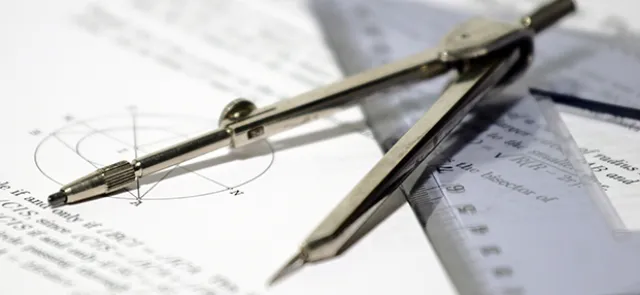
With a straightedge alone... or almost
According to the Poncelet–Steiner theorem, every straightedge-and-compass construction can be carried out with a straightedge alone, provided that a fixed circle and its center are given. But how is this done in practice? Though the question may seem playful or even pointless, it has in fact attracted the attention of several mathematicians.
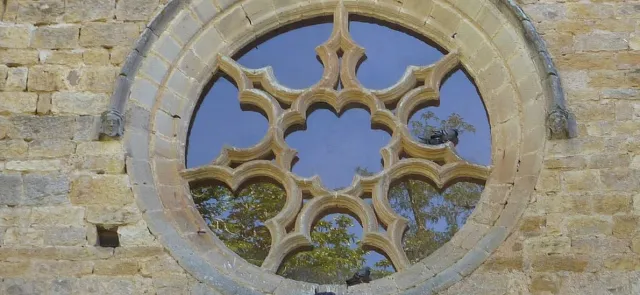
The builders' geometric constructions
Several centuries before the Renaissance, whether building a church or a fortress, builders needed only a compass and an unmarked straightedge to draw arcs, pointed arches, basket-handle arches and rose windows. Let us explore the basic geometry behind their methods.