



Math for everyone
Mathematical content accessible to everyone
Poincaré's qualitative approach to analysis | Tangente
Every high-school student learns how to express the real roots of a quadratic equation explicitly in terms of square roots. This becomes much more difficult for higher-degree equations and impossible from degree five onward.

Poincaré conjecture in manifold topology | Tangente
By the end of the 19th century, following the work of Poincaré and many other mathematicians, including Bernhard Riemann (1826–1866) and Enrico Betti (1823–1892), the topology of surfaces in our ordinary space was well understood.
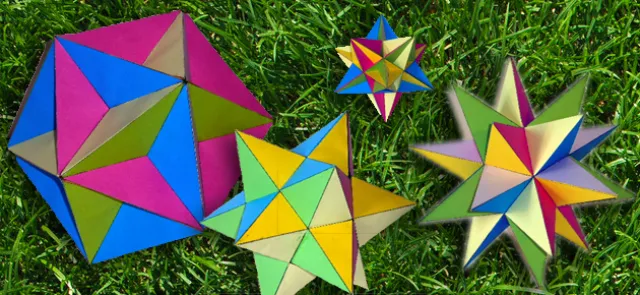
Polyhedra: from Euler's formula to Poincaré's characterization
What is a polyhedron? Throughout history, several characterizations have been proposed, only to be repeatedly undermined by the appearance of "monsters" serving as counterexamples. We look back at this epic story, which reaches its conclusion in Poincaré's work.
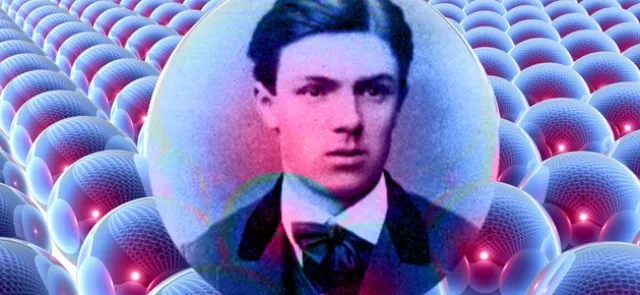
Poincaré and his heirs: the documentary | Tangente
Henri Poincaré, l'harmonie et le chaos (Henri Poincaré: Harmony and Chaos) is a 53-minute documentary made by Philippe Worms in 2012 and available online. Its unusual premise: the director brought six scientists together in a manor house for a weekend and filmed their informal conversations about Henri Poincaré.
The adoption of non-Euclidean geometries
Euclid's fifth postulate differs from the others: it seems provable. Yet its negation leads to other geometries, known as non-Euclidean geometries. They have their place within mathematics and have applications both in arithmetic, as Poincaré showed, and in general relativity.
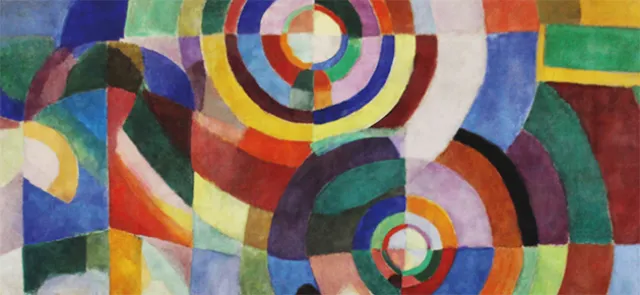
Poincaré and analytical Cubism: geometry and art | Tangente
As an artistic movement, Cubism grew out of a fundamentally mathematical approach to space, shortly after the publication of La Science et l’Hypothèse. In it, Henri Poincaré discusses the nature of space, and artists would strive to "turn his words into paintings."
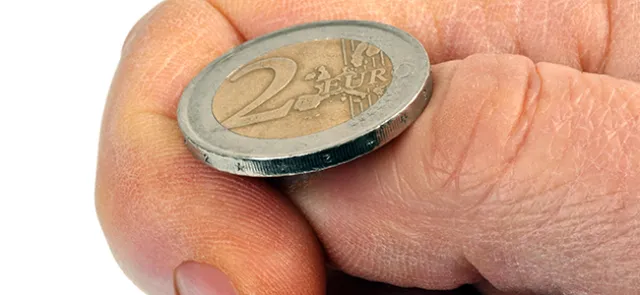
The calculus of probabilities according to Poincaré | Tangente
Poincaré is rarely associated with the calculus of probabilities. And yet his writings and teaching reveal much about his work and thinking on the subject. Although he did not revolutionize probability theory, he deserves credit for asking the right questions.

Poincaré vs Hilbert: intuition and logic | Tangente
The debate between Henri Poincaré and David Hilbert illustrates two opposing views of the nature of mathematics.
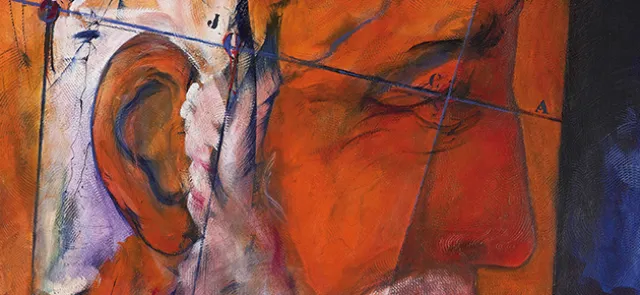
Jacques Dominioni, painter of geometry | Tangente
The work of the painter Jacques Dominioni (1934–2014) belongs primarily to lyrical abstraction. Yet his mastery of basic geometric forms—lines, circles and the grid structure underlying his paintings—is thought-provoking... and moving. Let's explore the different periods of his artistic output.
Euclid's algorithm, et cetera
A history of arithmetic—or how an algorithm dating from the third century BCE has endured through the ages and evolved to serve modern disciplines, particularly computer science and cryptology.

Creators' secrets
Where do ideas come from when creating a mathematics problem? How can anyone still find original material when so many topics have been explored over the centuries? How do you keep coming up with something new after devising hundreds of problems? How do you entice and engage the reader?

The rider's technique in show jumping
The properties of centers of mass can be cleverly exploited to improve how a rider and horse clear obstacles. Geometry, too, can serve the cause of sport!

Discovering barycentric curves
Barycentric curves do exist!

Convex sets and line segments | Tangente
It is fairly easy to tell whether or not a subset of the plane is convex.
The mathematics of chance at the heart of physics
The idea of introducing probability measures into models of physical phenomena dates back to the 19th century and runs through the work of Josiah Gibbs. The approach can be illustrated quite simply using... two magnets.
Elegant problem-solving methods (2) | Tangente
The beauty of mathematical problems often lies in an imaginative method—a "haha," as Martin Gardner called it—that makes the solution seem obvious, provided we can find a fresh perspective.
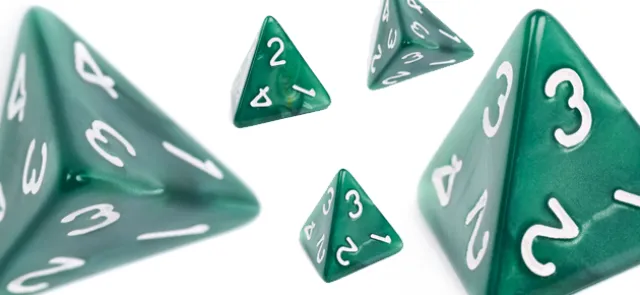
Area and barycenter
Barycentric coordinates offer a fresh approach to Routh's theorem and its applications to several results in Euclidean geometry.
Weighted systems in astronomy
Planetary systems are represented mathematically using barycenters.
Using barycenters in proofs
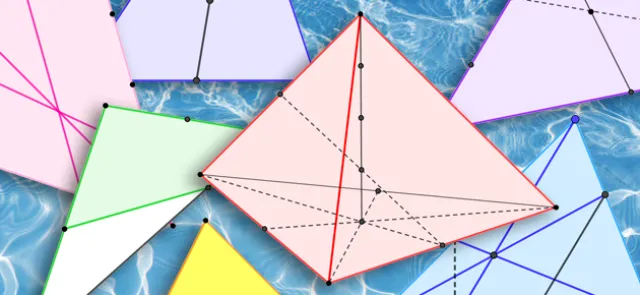
First used in physics and mechanics, the concept of the barycenter has proved a rich source of mathematical results. Alignment, incidence, construction and locus problems: geometry can hardly do without it!
An affine concept inspired by physics
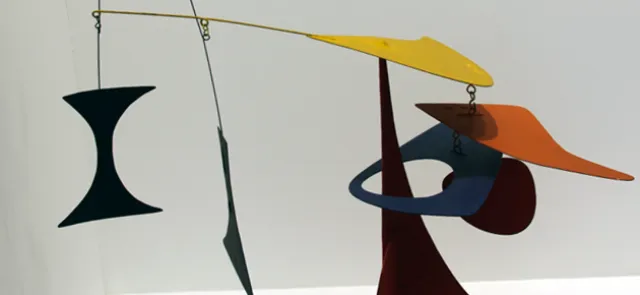
The midpoint of two points and the center of gravity of a triangle are familiar concepts from middle school onward. What do they have in common? How can they be generalized? In the early 19th century, a new approach to geometry put them on a firm mathematical footing through the concept of the barycenter.