



Maths and philosophy
Links between mathematics and philosophical thought, epistemological questions
 Podcast
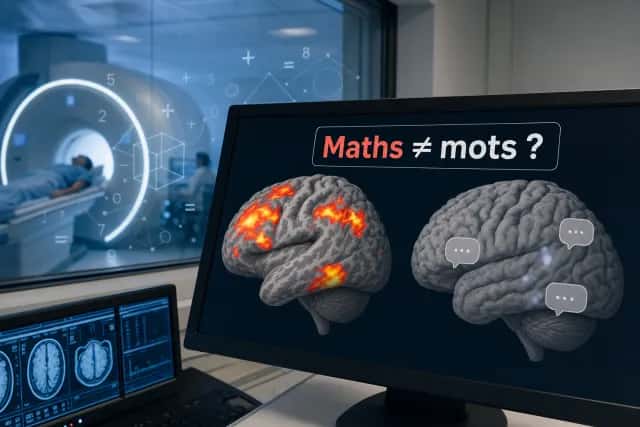
Do you think in words when solving an equation?
Neuroscience reveals that the brain processes mathematics through networks distinct from those of natural language, calling into question our understanding of mathematical cognition.
 Podcast
Did Leibniz really invent the ancestor of the computer?
The article dispels the myth of Leibniz as a forerunner of the computer by examining the historical reality of his universal-language project.
 Podcast
When AI "solves" a conjecture without proof: mathematicians push back
The mathematical community is mobilizing in response to AI's claims. The Leiden Declaration draws the line between generating and verifying proofs.
 Podcast
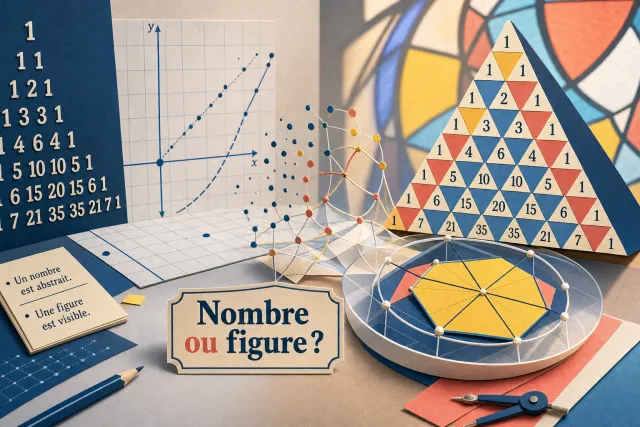
Geometry as incarnation: Pascal and the primacy of figures
How Blaise Pascal favored figures over numbers, even solving combinatorial problems through the geometry of the arithmetic triangle.
 Podcast
Leibniz and the best of all possible worlds: mathematics and philosophy
How Leibniz uses mathematics to justify the existence of the best of all possible worlds through infinitesimal calculus, symmetry, and philosophy.
 Podcast
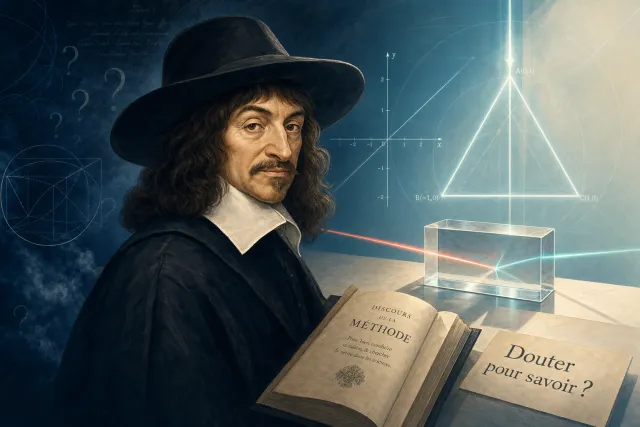
The three certainties on which Descartes built all of his physics
How Descartes built his philosophy on three certainties: the existence of the thinking subject, divine goodness, and mathematical rigor.
 Podcast
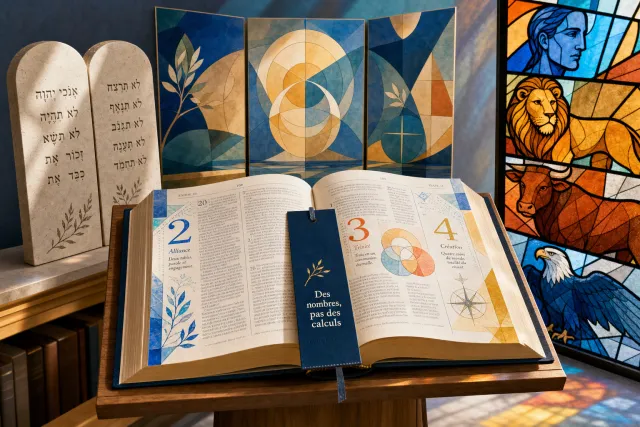
Number symbolism in the Bible: the spiritual meaning of 2, 3 and 4
Explore the spiritual meaning of the numbers 2, 3 and 4 in the Bible: the divine covenant, the Trinity and the whole of creation.
 Podcast
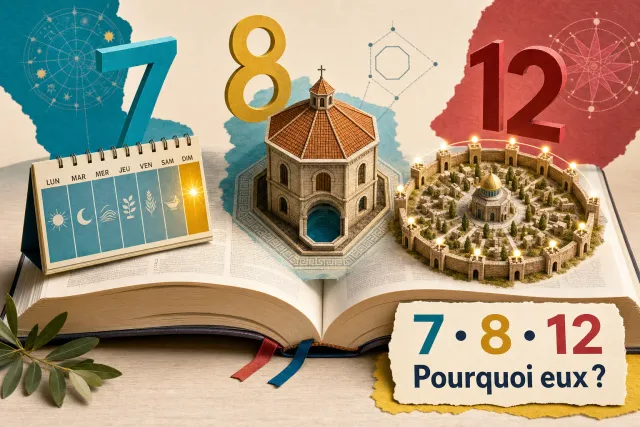
The Bible’s sacred numbers: 7, 8 and 12
Discover the symbolic meaning of the numbers 7, 8 and 12 in the Bible and their impact on culture, architecture and the Christian faith.
 Podcast
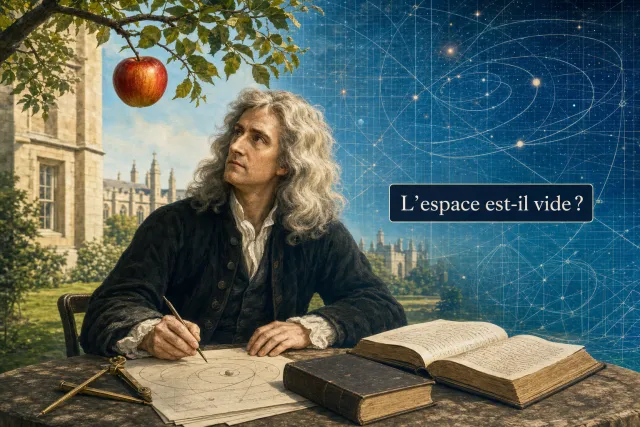
Newton on space and the divine: a philosophical and historical analysis
Isaac Newton revolutionized our understanding of space by conceiving it as an absolute mathematical framework, distinct from the bodies within it.
 Podcast
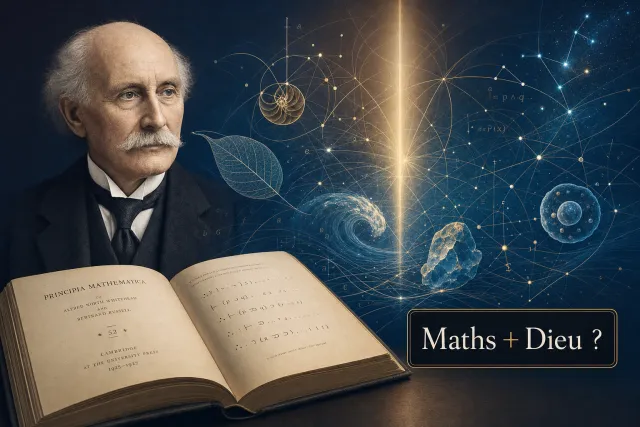
Whitehead: logical harmony of mathematics and philosophy
A journey into the thought of Alfred North Whitehead, who laid the foundations of the Principia Mathematica with Russell and developed a metaphysics of the cosmos in which God and mathematics work together in the world's unfolding.
 Podcast
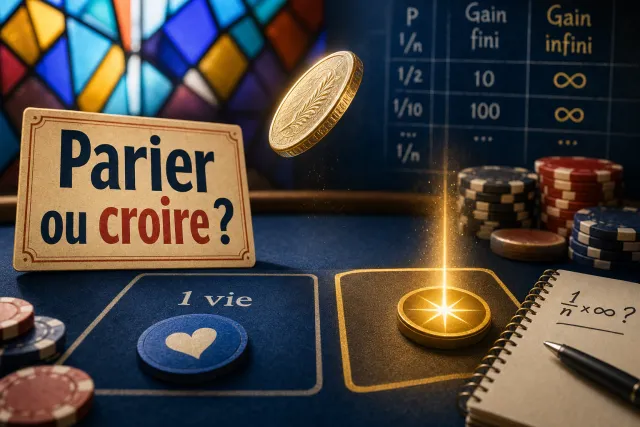
Pascal's Wager: probability and faith in mathematical analysis
An explanation of Blaise Pascal's famous argument about the wager of faith, applying probability theory to the question of God's existence.
 Podcast
Terence Tao and AI: what they are changing in mathematics
Terence Tao, a Fields Medalist, shares his experience with AI in mathematical research: an exploration partner that is transforming the way problems are formulated.
 Podcast
Theaetetus and the diagonal: why stop at √17?
How should we understand the famous passage in the Theaetetus where Theodorus mysteriously stops at the square root of 17? A new hypothesis emerges, involving continued fractions and triangular numbers.
 Podcast
Mirzakhani: thinking in pictures | Tangente
Even before her research career began, Maryam Mirzakhani started filling small notebooks with drawings of imaginary surfaces resembling fantastical worlds. Some of these sketches, which she found "simply beautiful," inspired several of her works in topology.
 Podcast
The Book of Changes and Leibniz's binary system | Tangente
The Book of Changes is a seminal work in the history of Chinese thought and has notably influenced several mathematical texts. Its interest in permutations explains its importance.
 Podcast
Making art with the Conway knot | Tangente
An artist passionate about mathematics, Michel Delaunay creates works that plunge the eye into the infinity of geometric and topological aesthetics. He notably combines the potentialities of the cube with those of the Conway knot.
From Pascal to Poncelet
In the winter of 1812, the retreat from Russia ended in disaster. Jean-Victor Poncelet (1788–1867), a 24-year-old military engineer, was taken prisoner. Steeped in Gaspard Monge's (1746–1818) descriptive geometry, he laid the foundations of modern projective geometry in the prison camps of Saratov, without books or instruments.
 Podcast
The abacus mindset: soroban and mental arithmetic | Tangente
The enduring use of the abacus has made Asia the continent where mental arithmetic is most highly developed. Competitions are held there, and the leading experts regularly set new records.
 Podcast
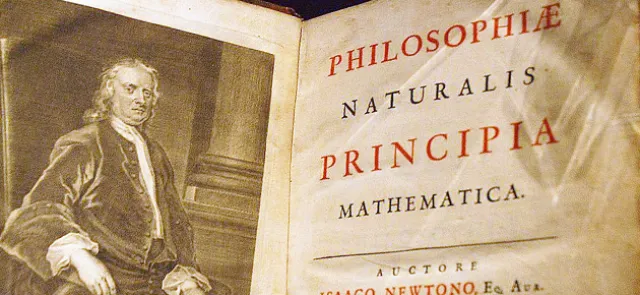
More than a translation of Newton | Tangente
Émilie du Châtelet is famous for having translated Isaac Newton's scientific work into French. Yet she did not simply reproduce the Latin text identically in French; she undertook an original rewriting of the proofs and concepts of Newtonian physics.
 Podcast
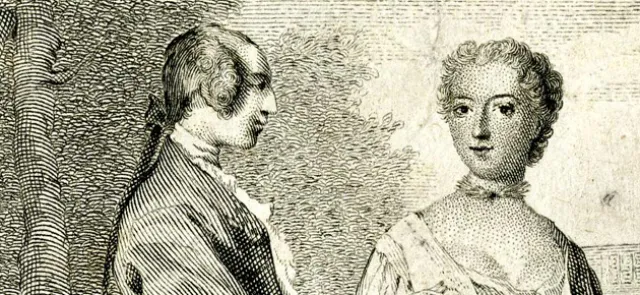
The marquise and the scholars of her time | Tangente
Among masters and peers alike, the marquise may have been unique for her sex, but she was not alone, as her many intellectual exchanges with the scholars of her time attest: Maupertuis, Clairaut, Euler, Kœnig, Johann II Bernoulli, Cramer, among many others.