



History and Culture
History of mathematics and cultural connections
 Podcast
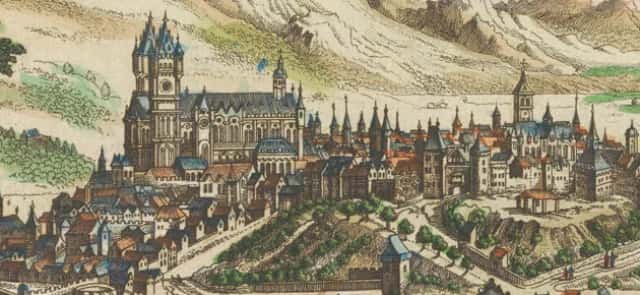
Plotting algebraic curves in the 18th century: Newton’s and Cramer’s analytic methods
How did Gabriel Cramer plot algebraic curves in 1750? Discover Newton's analytical parallelogram and Cramer's analytical triangle.
 Podcast
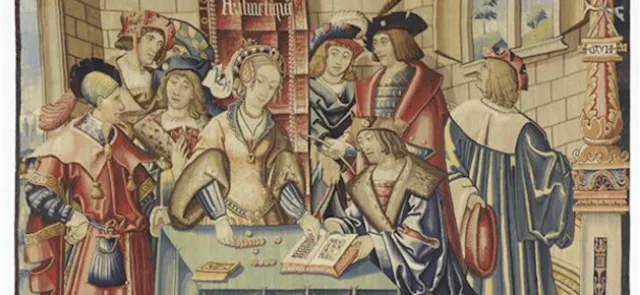
Gabriel Cramer: the journey of an 18th-century Genevan mathematician
Explore Gabriel Cramer's journey, from his education in Geneva to his European Grand Tour among the leading mathematicians of his day.
 Podcast
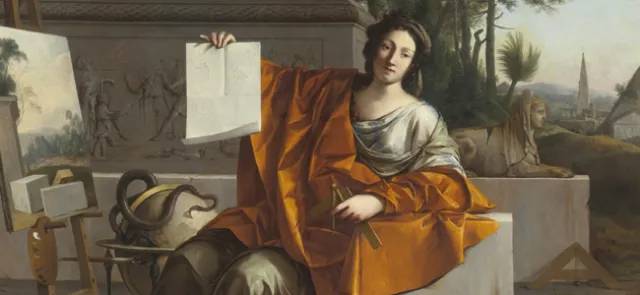
History of official statistics: from antiquity to Insee
A look back at the evolution of counting and enumeration methods, from ancient Rome to the creation of Insee in 1946.
 Podcast
Women mathematicians: a long-ignored history
This article explores the place of women in mathematics across the centuries, from the ancient world to the present day, and sheds light on those who have for too long been forgotten.
 Podcast
666: When the devil shows up in math | Tangente
From the biblical 666 to the Belphegor number, certain numbers send a shiver down the spine… and bring a smile to mathematicians' faces. Behind these "cursed" objects, the creativity and ingenuity of recreational mathematics run wild, ranging from number games to diabolical curiosities.

A tribute to Michèle Audin | Tangente
Michèle Audin, a mathematician at the University of Strasbourg who specialized in symplectic geometry (at the intersection of differential geometry and dynamical systems), died on November 14, 2025.

Blaise Pascal’s Pascaline | Tangente
This past November 19, a Pascaline dating from 1642, valued at between two and three million euros, was due to go under the hammer at Christie’s in Paris.
 Podcast
Conway's power trains | Tangente
Power trains are iterated functions introduced by Conway.
 Podcast
Mirzakhani's mathematical vision | Tangente
In 2020, George Csicsery directed a documentary about Maryam Mirzakhani titled Secrets of the Surface: The Mathematical Vision of Maryam Mirzakhani. Through numerous firsthand accounts, it reveals the life, personality and work of the Iranian mathematician.
 Podcast
The magic wand theorem | Tangente
Maryam Mirzakhani is also known for having obtained, with Alex Eskin and Amir Mohammadi, the magic wand theorem, so named because it made it possible to solve at a stroke many previously inaccessible problems. To explain it, let's first delve into translation surfaces. The illumination problem is one of its many applications.
 Podcast
Mirzakhani's geodesics
Maryam Mirzakhani first became known for the work she carried out for her thesis, in which she counts closed geodesics on hyperbolic surfaces. To explain her results, we will take a short tour through the world of hyperbolic geometry.
 Podcast
Mirzakhani: a revolutionary medal | Tangente
On August 13, 2014, Hassan Rouhani, president of the Islamic Republic of Iran from 2013 to 2021, congratulated Maryam Mirzakhani on Twitter on winning the Fields Medal, along with two photographs: one showing her wearing a hijab, the other showing her bareheaded.
 Podcast
Maryam Mirzakhani prizes | Tangente
The first woman and the first Iranian to receive the Fields Medal, Maryam Mirzakhani broke a historic barrier. Her visual approach turned mathematical problems into veritable landscapes. Today, numerous prizes bear her name to encourage young women pursuing research.
 Podcast
Mirzakhani: thinking in pictures | Tangente
Even before her research career began, Maryam Mirzakhani started filling small notebooks with drawings of imaginary surfaces resembling fantastical worlds. Some of these sketches, which she found "simply beautiful," inspired several of her works in topology.
 Podcast
Maryam Mirzakhani, from Tehran to Stanford | Tangente
A brilliant, passionate young woman, Maryam Mirzakhani turned her curiosity into an exceptional scientific career. Her optimistic outlook and perseverance changed the place of women in a field long dominated by men. Her life, brief but luminous, continues to inspire.
 Podcast
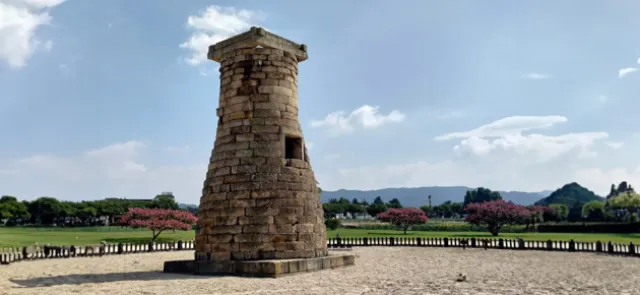
Algebraic tradition and innovation in Korea | Tangente
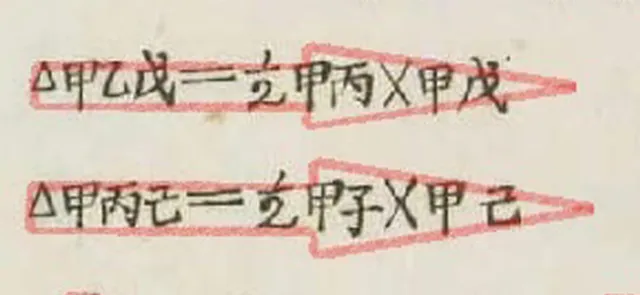
The tradition of examinations helped develop a culture blending tradition and innovation in 18th-century Korea. Thus, a Euler square was created even before Euler took an interest in the subject, while the Chinese method corresponding to Gauss-Jordan elimination was widely mastered.
 Podcast
Wasan to yōsan: Japan's Meiji math revolution | Tangente
The opening of Japan during the Meiji era brought changes in the way mathematics was done and written. Questions of method, but also of language, arose. Kikuchi Dairoku, the future Minister of Education of Japan, overhauled mathematics textbooks accordingly.
Sangaku: geometry in Japan's temples | Tangente
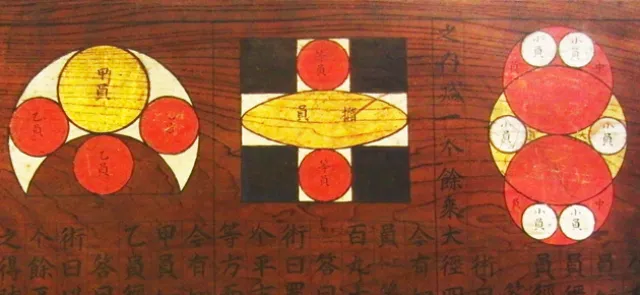
Sangaku are a remarkable practice, bringing together mathematics, art and spirituality. They offer a precious glimpse into the mathematics practiced during the Edo period and give a sense of how sophisticated popular mathematical culture was at the time.
 Podcast
Wasan: Japanese mathematics of the Edo period | Tangente
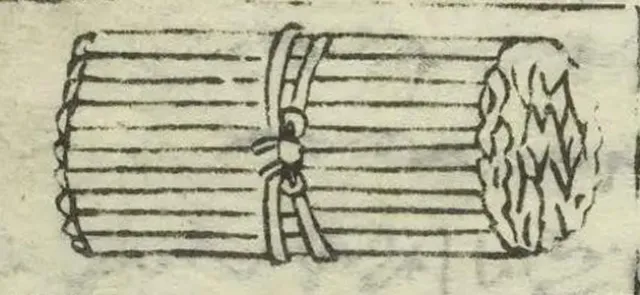
Rooted in the tradition of Chinese-language treatises, the Japanese mathematics of the Edo period (wasan) is far from a pale copy: the problems and methods developed at the time display remarkable originality in the history of mathematics.
 Podcast
How division was done in China
Once a polynomial equation is given, its roots can be found simply by applying a division algorithm. This algorithm is based on the process of division. Here are its main principles.