



Knowledge
In-depth articles on mathematical knowledge and theories

Thābit and the Pythagorean theorem
In Sur la preuve attribuée à Socrate au sujet du carré et de sa diagonale (On the Proof Attributed to Socrates Concerning the Square and Its Diagonal), Thābit ibn Qurra examines how squares can be dissected, taking as his starting point the famous example from Plato's Meno. This gives him an opportunity to present two proofs of the Pythagorean theorem and to generalize it.

Al-Khwārizmī's geometry of equations
Quadratic equations have been solved by geometric methods, of varying degrees of sophistication, since Babylonian times. Similar methods appear in the works of Greek authors. But al-Khwārizmī was the first to set out a clear, general method.

Bunk-bed conjecture in graph theory | Tangente
Bunk beds are not just furniture for children’s rooms, dormitories or barracks. They are mathematical objects too!

Conjectures finally settled! | Tangente
New developments in the famous "moving sofa problem" and advances in triangle dissection.
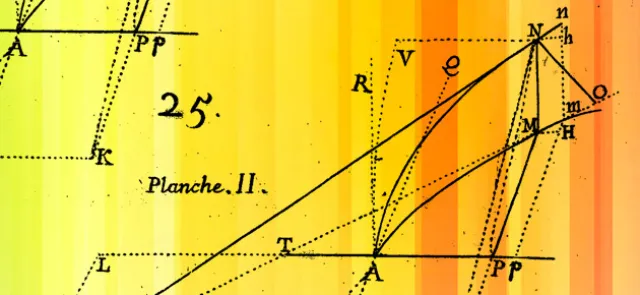
The geometry of curves
Alexis Claude Clairaut first came to the attention of learned circles through his book on curves of double curvature, presented to the Académie in 1729. He was only 16 at the time. The book was published in 1731, earning him election to the Académie des sciences at the age of 18.

2025: a very square number!
What better way to celebrate the new year than with some delightful mathematical properties of the number 2025? Tangente wishes all its readers a wonderful 2025.

Kepler, or the defeat of the circle
Kepler's first law states that planets follow elliptical orbits around the Sun. How can this be proved with the bare minimum of theory? To answer this question, physicist Richard Feynman produced a little gem of classical geometry applied to celestial mechanics.

Ellipse snippets
There are several ways to construct an ellipse. Here are a few.
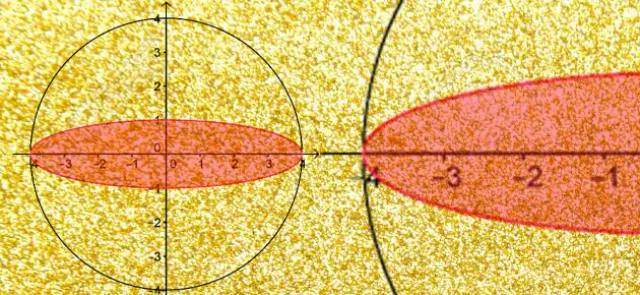
A question of circumference
You might expect calculating the perimeter of an ellipse—a fairly ordinary shape—to be straightforward. Yet it is a problem on which mathematicians have displayed extraordinary ingenuity. And in the formula contest, Ramanujan wins!
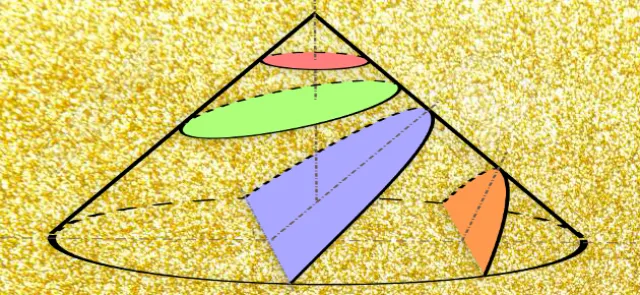
A little something missing
The term "ellipse" differs from the names of the other two conics, the parabola and the hyperbola. In fact, it means "something missing". Behind this surprising etymology lies a mathematical revolution: Apollonius of Perga's theory of conics.

The one-cut theorem: any polygon in a single cut | Tangente
Can a polygon be cut from a sheet of paper with a single straight cut? Surprisingly, the answer is yes! More surprisingly still, this also applies to other objects.

Squaring polygons
Archimedes' Stomachion, the world's oldest puzzle, can produce thousands of shapes from fourteen polygonal tiles. But what about the inverse problem? Under what conditions do two given polygons have a common polygonal dissection, and how can one be found?
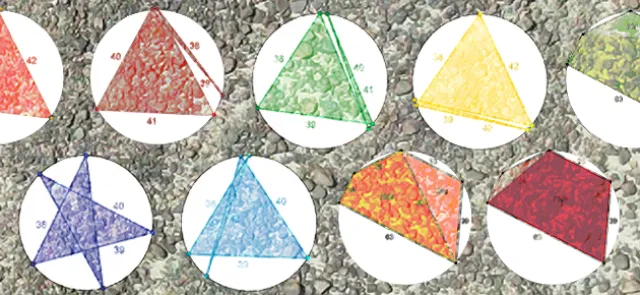
Robbins pentagons
While the geometry of triangles and quadrilaterals has been studied in detail for many centuries, the geometry of pentagons has only recently begun to be explored. Let's follow in the footsteps of Heron, Brahmagupta and Robbins.

Pythagoras and Heron
Heron's formula emerges when we seek to express the area of a triangle in terms of its side lengths. A variation of the argument recovers the Pythagorean theorem.
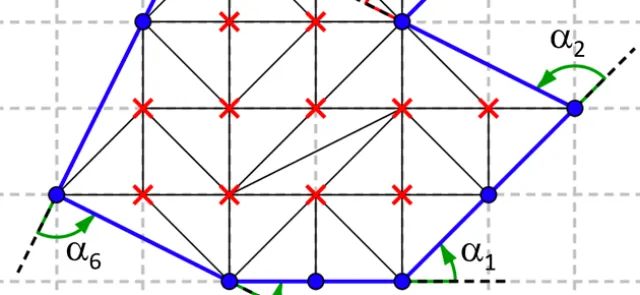
Pick's theorem: an inspiring formula for polygonal area | Tangente
Some theorems, through the simplicity of their statements and the originality of their proofs, become enduring examples of mathematical creativity. Pick's theorem is one such example.
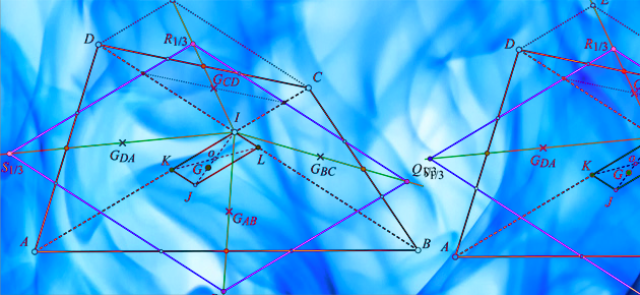
Convex quadrilaterals
Three sides completely determine a triangle, up to orientation. With four sides, infinitely many polygons can be constructed. Nevertheless, many general properties can be established for arbitrary convex quadrilaterals.

Regular polygons
Regular polygons are particularly harmonious, thanks to their symmetries. At first glance, one might think they had long since yielded all their secrets. Yet the notion of duality reveals a wealth of surprises.

What is a polygon? A rigorous definition | Tangente
The definition of a polygon seems intuitive and obvious. Yet when we try to pin down this mathematical object more precisely, several definitions are possible, and the most recent ones may defy common sense.
Conquering spaces
Sequences and functions can have limits. But the need arose to define these ideas abstractly. The emergence of set theory and algebraic structures led, in the early 20th century, to the concepts of metric, topological and normed spaces. Here is their fascinating story.
Structuring randomness
Bringing order to the unpredictable is the aim of the concept of a probability space. By gathering the possible outcomes of a random experiment and their chances of occurring into a coherent structure, we can turn probability into an exact science.