Folders
Discover how great mathematicians shaped our world, explore the links between math and other fields like art, music, or even philosophy, and relive the key moments that marked its evolution.

To begin
This third special issue of 2020, which appears on schedule despite the tragic events of the year, is dedicated to Operations Research. The Tangente team thanks the two learned societies, ROADEF and GDR RO, which were deeply involved in its writing. Thanks to the members of the Scientific Committee, and in particular to Nadia Brauner, who devoted a lot of time to the success of this issue.












Topology, deforming without tearing
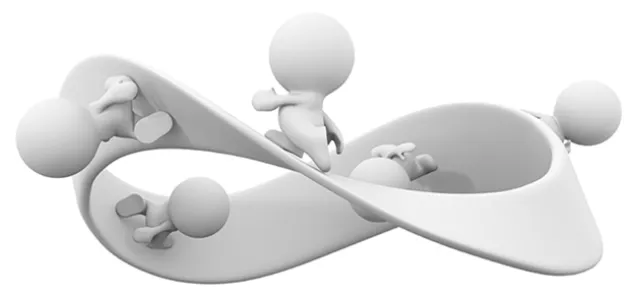
When an elastic object can, when it is deformed continuously without tearing, take the shape of another object, they have the same topological structure: they are said to be homeomorphic. A sphere and a cube (both hollow) are homeomorphic, but they are not with a torus. Topology provides a fundamental complement to analysis and to the definitions of limit or continuity by introducing new notions such as compactness. Welcome to this geometry "unlike any other"…

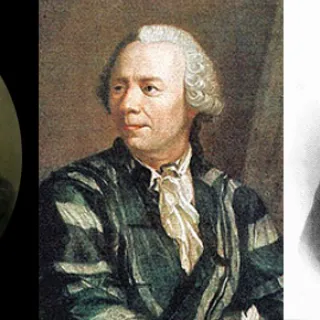

Transcendental friends
The emergence, in the time of the Greeks, of the notion of irrationality, with the impossibility, for certain numbers to be written as a quotient of integers, was a highlight of mathematics. Each new number was then subjected to the question: fraction or irrational? The proof, in the 19th century, of the irrationality of numbers like π or e, added a degree to the categorization: unlike others, such as √2, they were not solutions of a polynomial equation with integer coefficients. They were named transcendental, as if to remind that they came from a higher world. In fact, almost all real numbers are transcendental but for some irrationals, the question remains open.