



Games and Challenges
Mathematical problems, games and challenges

Blackjack: fluctuating probabilities | Tangente
Mathematicians have been studying blackjack since the postwar years. They discovered ways to improve players’ performance by applying probabilities both statically (basic strategy) and dynamically (card counting). But casinos changed the rules to protect themselves.

Bridge: Suit Combinations and Probability | Tangente
Bridge (and its ancestor, whist) is, along with chess, one of the two most celebrated games in the West, as the quotation below from Edgar Allan Poe attests — no doubt too flattering. Probability is often invoked in deciding which strategy to adopt.
Board games and chance: the maths of dice | Tangente
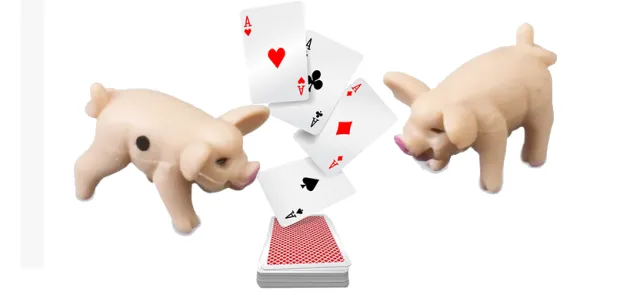
What role does chance play in a board game? It can vary widely, ranging from total dominance, where players have no say at all, to complete absence. Between the two extremes, the strategies of many games rely on optimizing probabilistic principles.

Nimbers applied to the game of Cram
The game of Cram consists in placing dominoes on a grid. Remarkably, its study can be reduced, via the definition of a category of mathematical objects called "nimbers", to the Marienbad matchstick game.

Half-move advantage in combinatorial games | Tangente
In a board game, it is fairly common, partway through a match, to feel that you are ahead of (or behind) your opponent. Through the example of Domineering, this article invites you to discover how John Conway formalized this notion.

The Mathematics of Tchoukaillon
Mancala is the generic name for traditional sowing games in Africa and Asia. One of the solitaire variants of these games gave rise to a mathematical recreation with unexpected properties and consequences.

Quarto!: Combinatorial reasoning and strategy | Tangente
Shape, color, size and topology (with or without a hole) are the four characteristics of a Quarto! piece. Since each has two possible values, the players facing off in this thrilling combinatorial game — one of the most award-winning in the world — must contend with sixteen pieces.

The projective geometry behind the Dobble game | Tangente
You would never guess it while playing Dobble: combinatorics, projective geometry and modular arithmetic can offer a new approach to constructing the game's various variants.

Mathador: the mental arithmetic game | Tangente
Mathador (Réseau Canopé, L2D), inspired by the famous television game shows "Des chiffres et des lettres" and "Le compte est bon", was created in 1999.
GTO: game theory applied to poker | Tangente
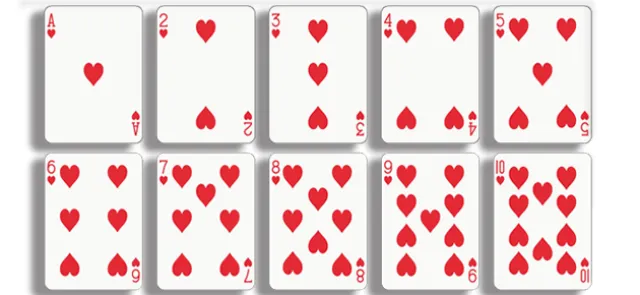
Game theory is not reserved for games "with complete information." It also applies to games where chance plays a part. In poker, it has today given rise to tools, available to online players, that let them play optimally in the first round of betting.
Learning maths through Go at school | Tangente
With adapted rules and smaller boards, Go provides a way to learn mathematics that can be introduced as early as preschool.

Ko in Go: rules and strategies | Tangente
A ko arises when a stone is threatened with capture, but after the opponent captures it, the capturing stone is itself in a position to be captured.
A short mathematical history of the game of go
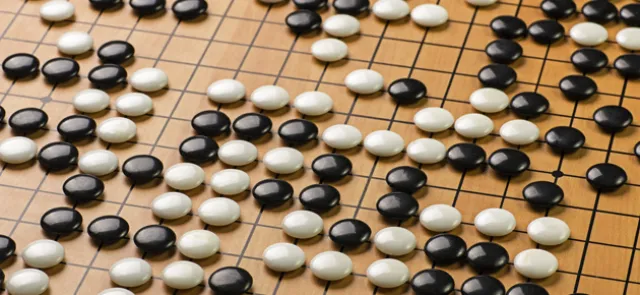
Both millennia-old, as a game and as a science, go and mathematics are two worlds of phenomenal depth that intertwine, enrich each other, and shed light on one another. Go constantly draws on various forms of mathematics, to the point of becoming a research subject in its own right.

Grundy's game: graphs and winning strategy | Tangente
Graphs are crucial to strategies in games of complete information, provided the positions are not too numerous and can be represented. Patrick Grundy devised a game to formalize these strategies.

Symmetric play in chess: does it work? | Tangente
In some two-player sequential games with complete information, one player may be tempted, when possible, to mirror the opponent's moves. When this gives one player a winning strategy, the game loses all interest unless the rules are changed to avoid this pitfall.
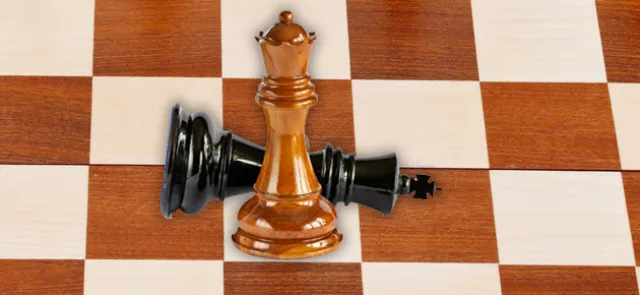
A strategy for moving the queen
Two players take turns moving a queen across a chessboard. This seemingly innocuous game offers a way to discover and illustrate a major result in game theory: the Sprague–Grundy theorem. It also has another mathematical surprise in store…

A new president for the CIJM | Tangente
At the end of January, Brigitte Bourgasser Wenner succeeded Marie José Pestel as head of the International Committee for Mathematical Games (CIJM).

Revisiting the classics… | Tangente
Numerous shows with mathematical content are regularly created. But might there be mathematics in theatre itself? We can revisit the classics from a different perspective. Let's reread Molière, Marivaux and Ionesco.

The Rubik's Cube group: The mathematics of the magic cube | Tangente
The Rubik's Cube is a hugely popular puzzle among children and adults alike. This object, too, has its own group: all the isometries that leave it invariant.

Problem-writing competition | Tangente
To mark the publication of issue 200, Tangente organized a problem-writing competition. Nine of the forty-three puzzles submitted received prizes, but many others deserved one too. We asked the jury members to single out their personal favorites.