Folders
Discover how great mathematicians shaped our world, explore the links between math and other fields like art, music, or even philosophy, and relive the key moments that marked its evolution.

At the crossroads of sciences
Was he a physicist or a mathematician? Henri Poincaré's vision goes beyond divisions, limits, and boundaries. Dominating all the physical sciences of his era, he taught electricity as well as optics or electrodynamics. It is by studying curves defined by differential equations that he examined with an innovative eye the old problem of the stability of the solar system and gave birth to dynamical systems, a theory at the frontiers of analysis, topology and celestial mechanics. Poincaré also played a determining role in the study of the speed of light, Maxwell's electromagnetic theory and the demonstration of the Earth's motion in the ether. With Lorentz, he developed the formalism of special relativity, which Einstein would later take up.

At the heart of his century
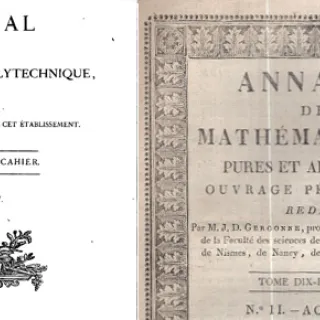
In this city of Paris, which could then claim the status of intellectual capital of Europe, Cauchy was the scientific pivot of his entire generation. Cauchy's glory was however nothing like a long tranquil river. Born in 1789, he was confronted with the great upheavals that swept through France for decades and saw regimes and revolutions chain one after another. If no one in his time truly contested Cauchy's scientific domination, his genius did not always protect him from the hazards of the era. His sometimes intransigent firmness on political and religious matters worked against him, giving him the image of a rigid man even as his charitable works also earned him great respect.

At the heart of the ellipse
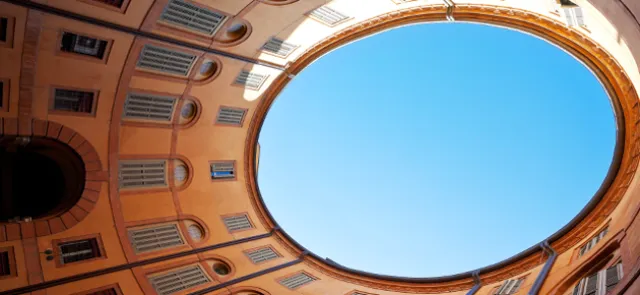
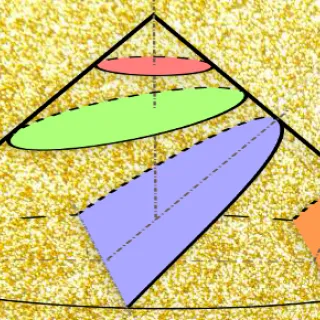
With the parabola and the hyperbola, the ellipse is one of the three conic sections. First examined in the context of solving problems requiring tools beyond the straightedge and compass, such as the duplication of the cube, they were later unified by their geometric definition as the intersection of a plane and a cone. The ellipse, which may seem to be merely a flattened circle, exhibits surprising properties, whether concerning the calculation of its perimeter, various construction methods one might devise, or the practical properties allowed by its focal definition, one of which is the proof of heliocentrism.

At the root of numbers
Extracting a root, for the famous scholar Cosinus, is a calculation session… at the dentist's. In maths, the methods for extracting square roots are multiple: exact or approximate, using sequences or functions, a calculator – it has become the modern reflex –, but also by hand, like at school for divisions, except that it's a bit more complicated. This will be an opportunity to discover a little-known technique for manually extracting cube roots! One can then easily generalize to complex roots, thanks to Euler, always him: their definition, the regular polygons they allow to draw, and what are called primitive roots with the concept of cyclotomic polynomial.

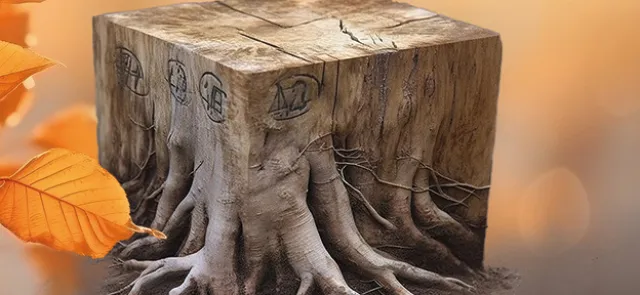
At the root of the square root
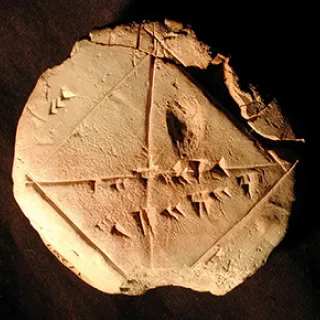
Essential in geometry as in analysis, square roots nevertheless took many centuries to establish themselves as full-fledged numbers in mathematics. The difficulty in evaluating them did not help their acceptance! In fact, one often has to calculate approximate values. For this, what better than a good algorithm? You undoubtedly know Heron's method or the digit-by-digit extraction method, but this feature will finally help you understand "why and how it works".
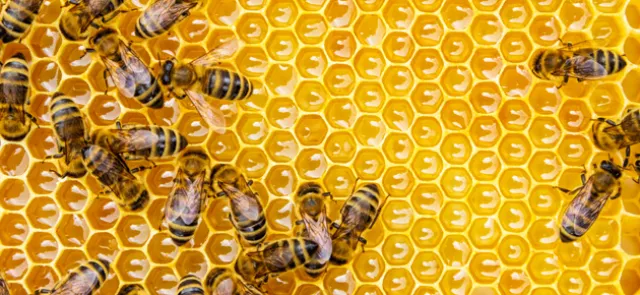
Bees, they can count!
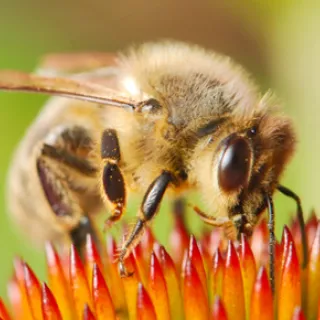
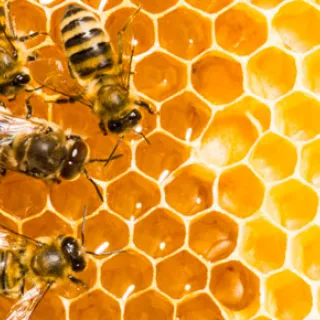
Bees are now at the center of public debate regarding the importance of their survival for natural balance. They are also fascinating for their unexpected mathematical abilities: they can count up to five and even perform simple operations! This suggests the idea of universality of the simplest mathematical reflexes and allows, in turn, for a better understanding of human phenomena such as learning in children or dyscalculia problems. However, their supposed geometric genius, which we think we perceive through the hexagonal shape of the cells, would not be their doing but attributable to physical laws. Let us go and harvest the mathematical honey of bees!

Bertrand Russell
One hundred and fifty years ago, one of the most original minds was born: Bertrand Arthur William Russell was a mathematician, logician, philosopher, free thinker... His writings earned him the Nobel Prize in Literature in 1950! His scientific work is colossal. With his accomplice Alfred Whitehead, he gave body to logicism, this school of thought aimed at making the foundations of mathematics rest on logic. His philosophical work is even more considerable. Russell never hesitated to rise against religious, moral or economic dogmas, which he saw as so many shackles from which societies and individuals are prisoners.


Beyond algebra
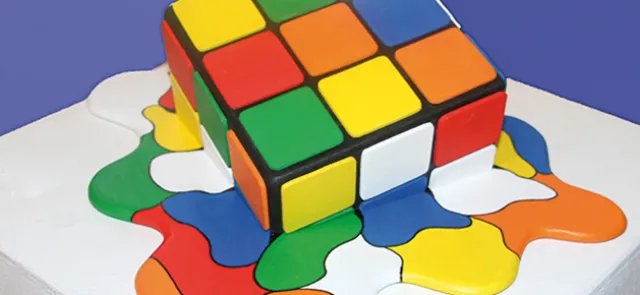
The notion of group, due to its structuring nature, is central in algebra. But it is also essential in geometry, where it allows us to understand, classify, relate, study transformations, and even characterize different geometries. Thus, if symmetries don't explain everything, they are often present, sometimes in an invisible manner. But the concept of group does not stop there: it has spread to other domains such as infinitesimal calculus and mathematical physics, where Lie groups have crucial importance.
Bold contributions to mathematics
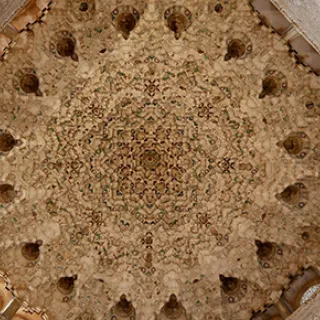
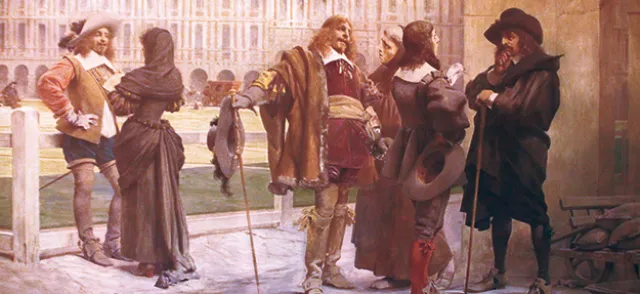
Blaise Pascal viewed geometry as the most beautiful profession. Seduced from a very young age by the classics of mathematical literature that his father entrusted to him, he devoured them until producing new results himself. He also developed new ways of reasoning by proving several properties by induction, a novel fact at the time. Arithmetic, conics, genesis of probability and combinatorics: all the domains attracted the prodigy from Clermont.


Books and mathematics
Literature and mathematics, is this an oxymoron? This year again, for the eleventh edition of the Tangente book prize, the selected works prove the opposite. This is the occasion to vote for your favorite. Also take advantage of summer to make new discoveries and make a wise choice of books about mathematics, thanks to the many reading notes published in our various issues, particularly in this feature. Writing and popularization enthusiasts are even invited to take up the pen as part of the Tangente best article prize.