Folders
Discover how great mathematicians shaped our world, explore the links between math and other fields like art, music, or even philosophy, and relive the key moments that marked its evolution.

Bright intelligence for everyday life
Symbols of the transformation to expect in our daily lives, embodiment of science-fiction dreams, speaking machines are only one of the facets of AI's penetration into increasingly varied domains. New learning methods, advice for playing (including on the stock market), translations, decision support, diagnostics, forecasts... New possibilities are available to humans to continuously increase their skills. What future for this essential relationship between interconnected humans and machines?
Bézout's theorem
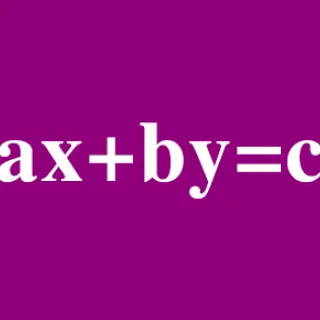
In its arithmetic version, Bézout's theorem is a true invitation to the discovery of "pleasing and delectable" problems, that Bachet de Meziriac had devised and that Tangente continues to offer you. Many elementary arithmetic results follow from it, and will allow you to exercise your sagacity. Bézout's theorem also comes in a polynomial version. This time, it has applications extending into integral calculus and plays a particular role in studying the intersection of algebraic curves.
Calculating ever faster
Throughout history, calculating better and faster has been an imperative, at the root of important stakes. Methods have multiplied, sometimes in surprising ways. Thus, Descartes used geometry to perform arithmetic operations! Mental calculation, with its tricks, has taken an important place in the teaching of mathematics, even if its approach has been revolutionized by the arrival of computers and calculators. The latter continue to adapt to integrate technological advances and remain essential pedagogical tools. Knowing how to calculate well remains indeed an imperative for good integration into society.

Can we measure everything?
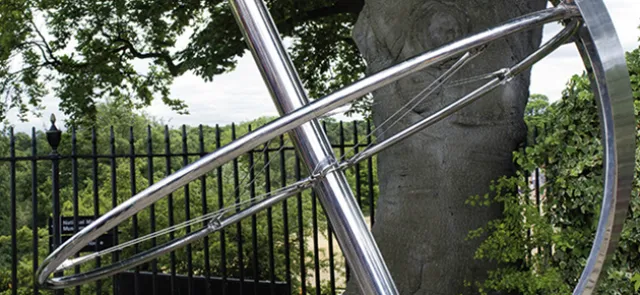
Omnipresent in the most varied areas of our daily lives, measurements seem natural to us. Standards, scales, gauges… are the tools that come to mind to establish them. Situated halfway between theory and experiment, they often rely on physical models which prove to be indispensable, especially when quantities, like the radius of the Earth, are inaccessible to direct measurement. Conversely, measurements can support or invalidate a theoretical model, like the existence of the ether. Finally, how can we assign a value to qualitative notions such as intelligence, happiness or even virtue?
Carbon, climate, energy
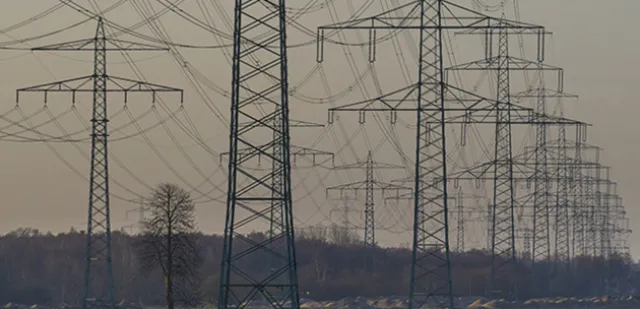
The Earth is warming, it is a statistical fact. With human responsibility being pointed out, more and more countries are encouraging "greener" initiatives, such as replacing coal with electric energy. Is the latter as virtuous as claimed? The interpretation of available data and some elementary calculations allow us to keep a cool head.

Circular reasoning
Georg Cantor and his set theory shook the foundations of mathematics by highlighting circular reasoning, that is to say, self-referential. At the turn of the 20th century, his paradoxes emerged under the pen of Burali-Forti, Russell and Richard, throwing Frege into dismay. Kurt Gödel showed that certain assertions cannot be proved or disproved within a given axiomatic framework, bringing a negative answer to a famous problem posed by Hilbert. Self-reference is also found in literature, painting, sculpture and… in the press where, intentional or not, it makes us smile.

Classics at the summit
Since Antiquity, people have been interested, for land redistribution problems, in calculating the area of a quadrilateral. The Indian mathematician Brahmagupta established a formula from the measure of its sides, a formula similar to that of Heron of Alexandria for triangles. A generalization of these expressions has recently made it possible to determine the area of any pentagon from its sides. Another ancient problem, the construction of regular polygons with a ruler and compass. It would be necessary to wait until the 19th century, the work of Gauss and the development of Galois theory, to determine which ones are indeed constructible according to the rules of Euclid.

Collaborative Mathematics
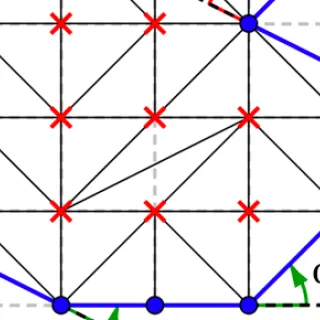
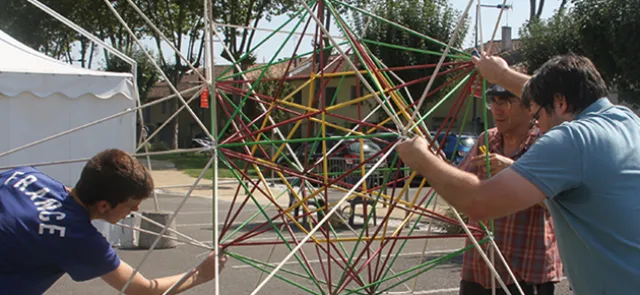
Mathematics is a collective work shaped over the centuries through collaborations, whether to produce knowledge or publications. But for less than a century, practices have been revolutionized. The isolated researchers of the past are increasingly being replaced by teams with varied skills, enabling new effective approaches. Massively collaborative research of results is also made possible by the Internet and instant communication tools. Pal Erdös was one of the pioneers of this movement of which the brilliant mathematician Tim Gowers is today one of the driving forces. But knowledge sharing also happens with the general public, thanks to popularization efforts and the commitment to allow free access to research articles. Collaborative free software is emerging, as are multi-author websites like Wikipedia. Large-scale knowledge sharing: the Ancients dreamed of it, our era is implementing it!

Comparison: a geometric origin
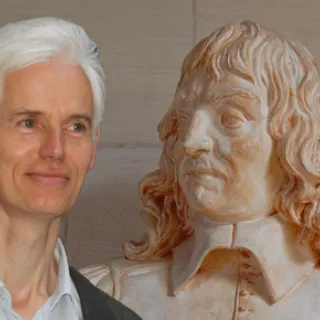
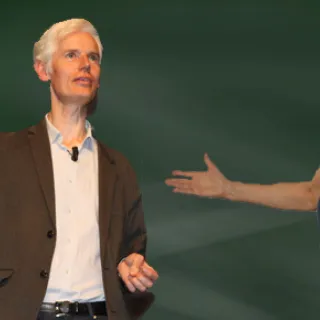
Comparing quantities is one of the most natural activities: who has the fewest objects, or the largest field? Before knowing all the mathematical tricks that allow one to increase the area of one's land or a precious capital, it is useful to return to the geometric origins of the question, in order to properly visualize the quantities at play. The triangle inequality and Dido's trick still amaze us today through their fruitfulness.


Complexes, trigonometry and analysis
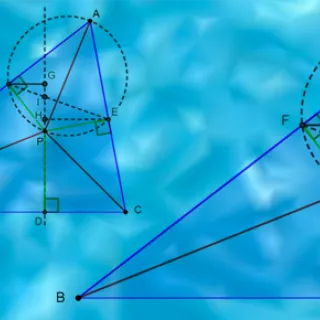
Complex numbers totally revolutionized analysis: by allowing the variable of a humble real function to take values in ℂ, Leonhard Euler and especially Bernhard Riemann opened a Pandora's box whose richness no one could have imagined. The exponential finally flourished, and with it all of trigonometry, whose formulas become accessible to everyone! Such that domains of physics, like electrical engineering, can no longer do without it. The zeta function now makes us gaze at a thousand mathematical wonders, especially regarding prime numbers, the elementary building blocks of arithmetic. But beware the rash soul who ventures into the Riemann hypothesis: the million-dollar reward promised for its proof alone speaks to the immense scale and formidable challenge of the task…