Folders
Discover how great mathematicians shaped our world, explore the links between math and other fields like art, music, or even philosophy, and relive the key moments that marked its evolution.
Diagrams for solving
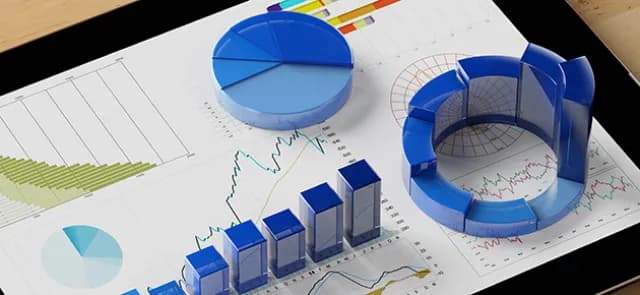
A picture is worth a thousand words! The power of images also lies in what they allow us to convey information. The diagram thus becomes a tool for thinking and problem-solving. Mathematicians have vied with each other in imagination to visualize data, make their results "jump out", and even justify them. Proofs without words, diagrams, Venn diagrams, trees, Karnaugh maps, nomograms and other modes of representation are all visual supports that have allowed a simplified view on all areas of mathematics.


Digital Arts
Born with the development of computer science, digital art has enabled artists, by appropriating algorithms and programming languages, to explore new fields and to "dialogue" with their audience through abstract creations. Initially exploiting the use of repetitive patterns, this new art has opened, as technological opportunities arose, to fruitful and unexpected collaborations. Mathematics, omnipresent, once again shows that it can contribute to harmony. Iterative processes, simulation of randomness, exploration of numbers and combinations, use of analysis in music, artists play with these concepts. This confluence is also an opportunity to question the very notion of creation. Is writing a computer program part of it? And what about the increasingly numerous works generated by artificial intelligence?


Digits and…numbers
Just as a word is composed of letters, a number is made up of digits. Our positional decimal system (which uses ten digits, whose position in the writing of the number matters) is a way — quite powerful — to represent a number. But what effects can be obtained by manipulating this sequence of digits? The creativity brought by some in the search for answers to this question opens the door to a new universe. You will discover happy, narcissistic or palindromic numbers, the notions of persistence, some intriguing properties of prime numbers... and many other curiosities.

Diophantine equations
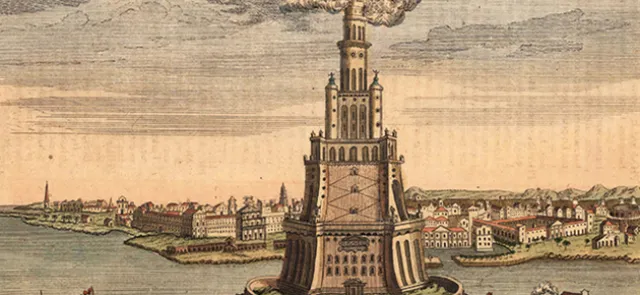
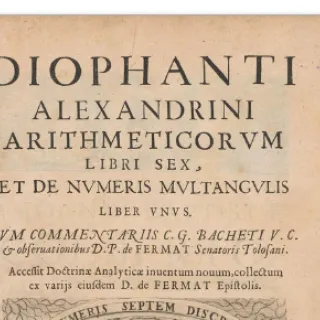
At the crossroads of arithmetic, algebra and analysis lies an illustrious unknown: Diophantus. While nothing is known of his life, the equations bearing his name have given rise to a vast body of literature linking great names such as Pythagoras, Euclid, Fermat, Bézout, Bachet de Mézirac, Lagrange, not forgetting, among so many others, Hypatia and Sophie Germain. This dossier is thus an opportunity to discover the history of Diophantine equations, to show a side of Fermat less well-known than that of his famous "Last Theorem" as well as to marvel at mathematical ingenuity through clever solutions in the form… of billiards!
Discontinuity
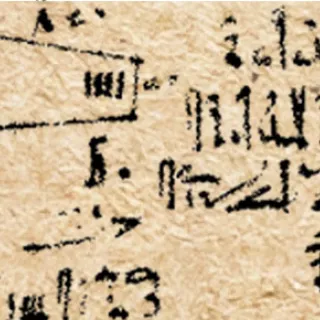
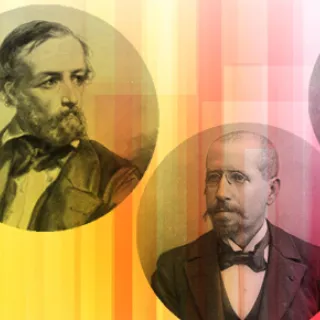
Breaking with the search for regularity in scientific phenomena, the interest in discontinuous functions suddenly appeared at the beginning of the 19th century with the study of Fourier series. Greater rigor was then imposed to define the concepts of function, continuity, differentiability. Riemann, Lebesgue, Darboux and others proposed examples of monstrous functions to justify the interest in the theories they had developed, opening the field to new approaches in physics and even economics.


Discovering differential equations
Don't be afraid of them! Behind an often confusing formalism, differential equations are an extremely powerful area of mathematical analysis. They have become indispensable due to the need to solve concrete problems in many fields where they play a fundamental role. First used in geometry and physics, they now enable, in most sciences and many engineering fields, the modeling of phenomena involving a continuous variable. And when it is impossible to find an exact solution, one can determine an approximate solution with the help of numerical schemes or computers.


Discrete geometry, at the crossroads of disciplines
Discrete geometry is a field at the crossroads of several disciplines, such as geometry, arithmetic or combinatorics. To get an idea, let us replace the continuous Euclidean plane with a grid, made up of points with integer coordinates. The geometric objects we encounter there are, for example, polygons whose vertices lie on these points. Can we define a line, a circle? These questions arose with particular acuity from the 1950s onwards, when it became necessary to represent images on screens, discrete sets of pixels. Many problems in discrete geometry are still open and lead to exciting developments.


Dissections
Recreations around geometric dissections (or dissections) are found in all civilizations. Squares, rectangles, polygons and, for about fifty years, polyominoes, provide an inexhaustible mine of puzzles whose elegance often lies in their simplicity. This area of geometry also holds real mathematical questions: can two figures of the same area be obtained, one from the other, using a simple pair of scissors? A theorem answers the question.

Distances to solve problems
After the time of conceptualization came that of applications in very varied fields, very often outside the field of mathematics, such as linguistics, physics or medicine. Many problems are solved there by building an appropriate distance, whose interpretation opens an extraordinary field to issues of our daily life. It becomes possible to measure a distance between words, between curves, between images. Who could believe that bank account numbers, the spell checker in your word processor or the interpretation of your blood test results rely on this concept? Discover some of these applications…


Divisibility
An inexhaustible source of arithmetic wonders, divisibility criteria are far from all being known… and even farther from being mastered! Everyone knows how to recognize an integer divisible by 2, 3, 5, 9 or 10 or by one of their products. Divisibility by 11 is already a bit less familiar. But what about divisibility by prime numbers such as 13, 17, 19, 23 or 29? You're stumped? Yet there are simple tricks that make it possible to develop criteria for each of them. As early as the 17th century, Pascal had developed some to help merchants. Other original algorithms continue to thrive today, such as those of Vosburgh Lyons.